
Beyond the Horizon: Decoupling Multi-View UAV Action Recognition via Partial Order Transfer
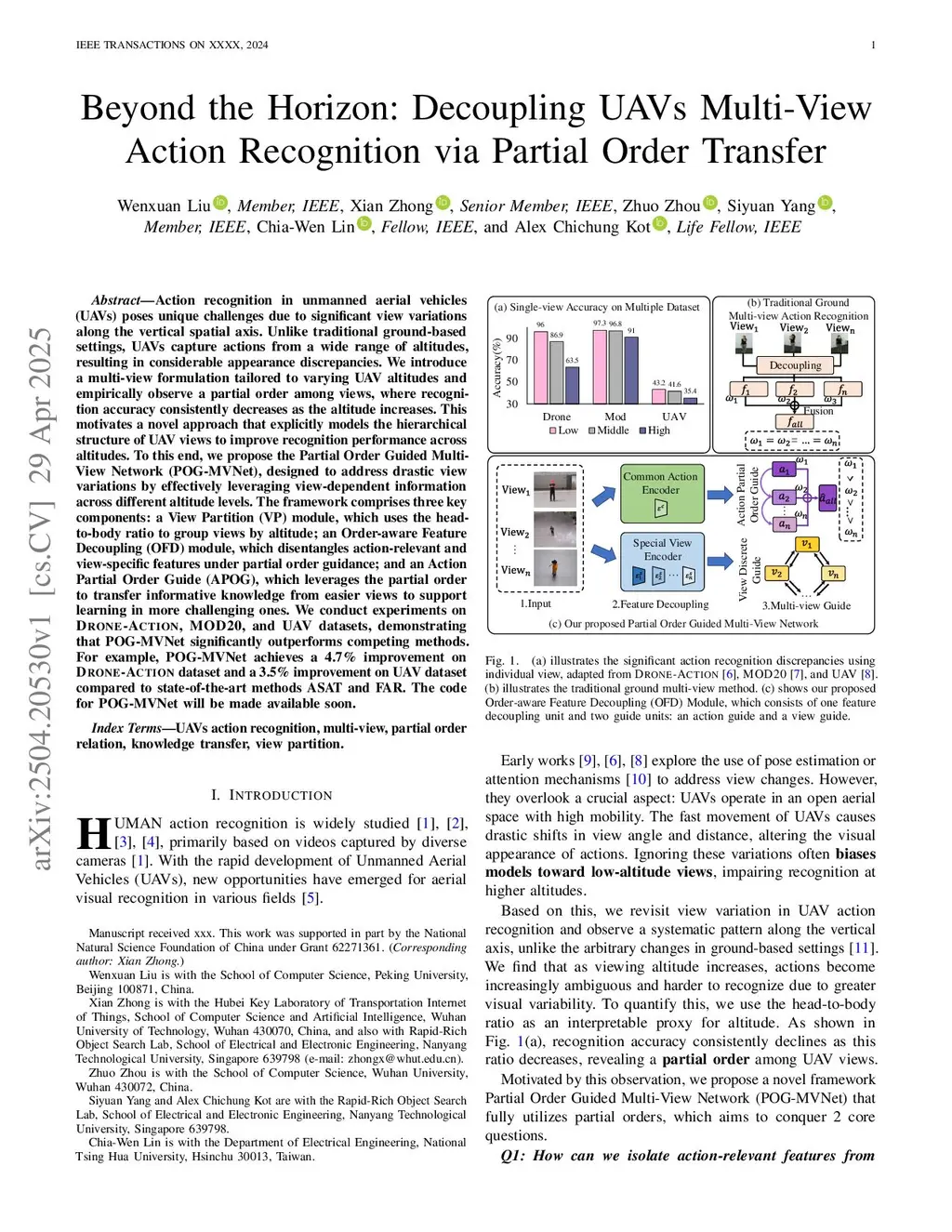
Action recognition in unmanned aerial vehicles (UAVs) poses unique challenges due to significant view variations along the vertical spatial axis. Unlike traditional ground-based settings, UAVs capture actions at a wide range of altitudes, resulting in considerable appearance discrepancies. We introduce a multi-view formulation tailored to varying UAV altitudes and empirically observe a partial order among views, where recognition accuracy consistently decreases as altitude increases. This observation motivates a novel approach that explicitly models the hierarchical structure of UAV views to improve recognition performance across altitudes. To this end, we propose the Partial Order Guided Multi-View Network (POG-MVNet), designed to address drastic view variations by effectively leveraging view-dependent information across different altitude levels. The framework comprises three key components: a View Partition (VP) module, which uses the head-to-body ratio to group views by altitude; an Order-aware Feature Decoupling (OFD) module, which disentangles action-relevant and view-specific features under partial order guidance; and an Action Partial Order Guide (APOG), which uses the partial order to transfer informative knowledge from easier views to more challenging ones. We conduct experiments on Drone-Action, MOD20, and UAV, demonstrating that POG-MVNet significantly outperforms competing methods. For example, POG-MVNet achieves a 4.7% improvement on Drone-Action and a 3.5% improvement on UAV compared to state-of-the-art methods ASAT and FAR. Code will be released soon.
View on arXiv