
Learning-Augmented Power System Operations: A Unified Optimization View
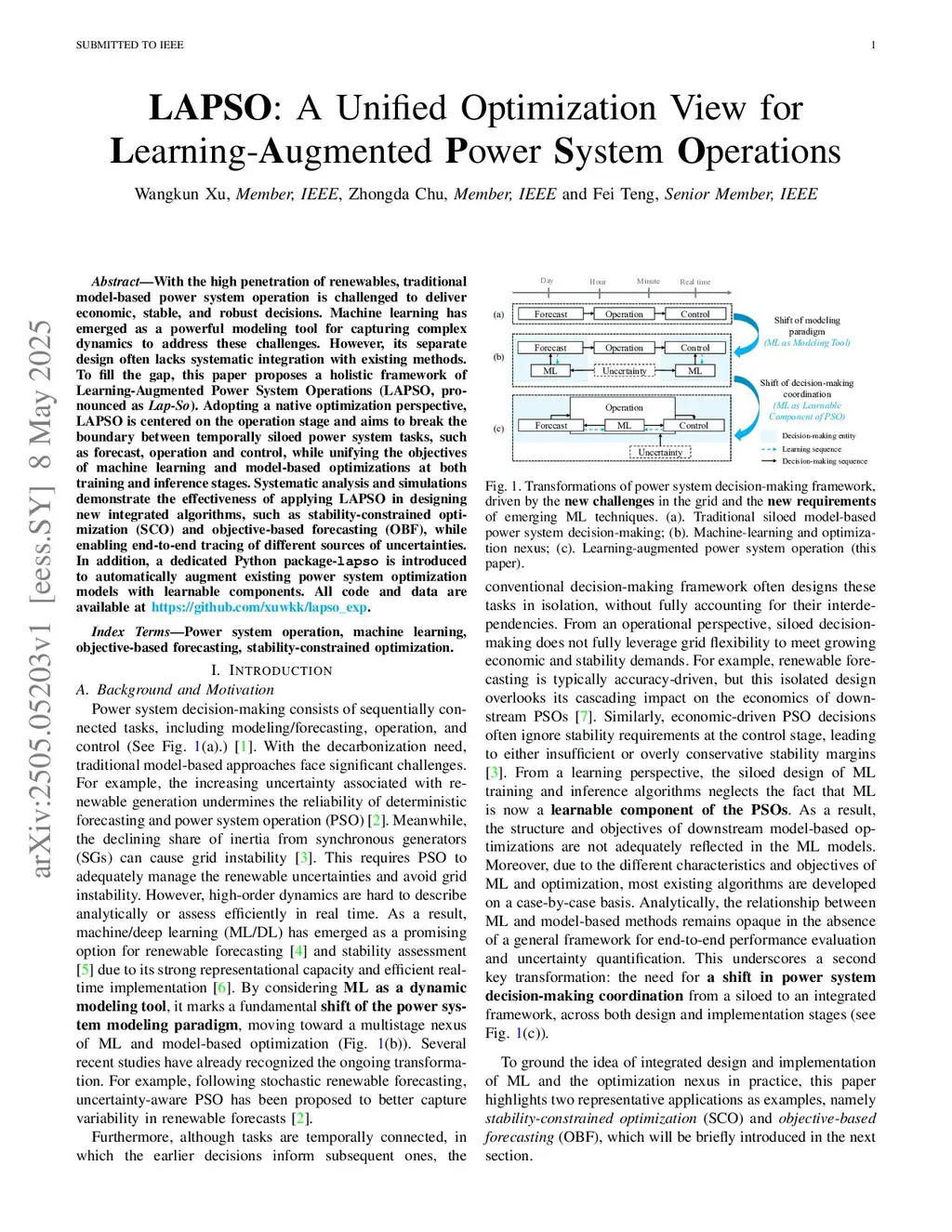
With the increasing penetration of renewable energy, traditional physics-based power system operation faces growing challenges in achieving economic efficiency, stability, and robustness. Machine learning (ML) has emerged as a powerful tool for modeling complex system dynamics to address these challenges. However, existing ML designs are often developed in isolation and lack systematic integration with established operational decision frameworks. To bridge this gap, this paper proposes a holistic framework of Learning-Augmented Power System Operations (LAPSO, pronounced Lap-So). From a native mathematical optimization perspective, LAPSO is centered on the operation stage and aims to unify traditionally siloed power system tasks such as forecasting, operation, and control. The framework jointly optimizes machine learning and physics-based models at both the training and inference stages. Then, a complete set of design metrics is introduced to quantify and evaluate the impact of ML models on the existing decision-makings. These metrics facilitate a deeper understanding of representative applications such as stability-constrained optimization (SCO) and objective-based forecasting (OBF). Moreover, LAPSO is inherently extensible to emerging learning paradigms that integrate forecasting, operation, and control in a closed loop. It also enables the systematic identification and mitigation of different sources and timings of uncertainty from Bayesian perspective. Finally, a dedicated Python package \texttt{lapso} is developed to automatically augment existing power system optimization models with learnable components. All source code and datasets are publicly available at:this https URL.
View on arXiv