
On the Failure of Latent State Persistence in Large Language Models
- LRM
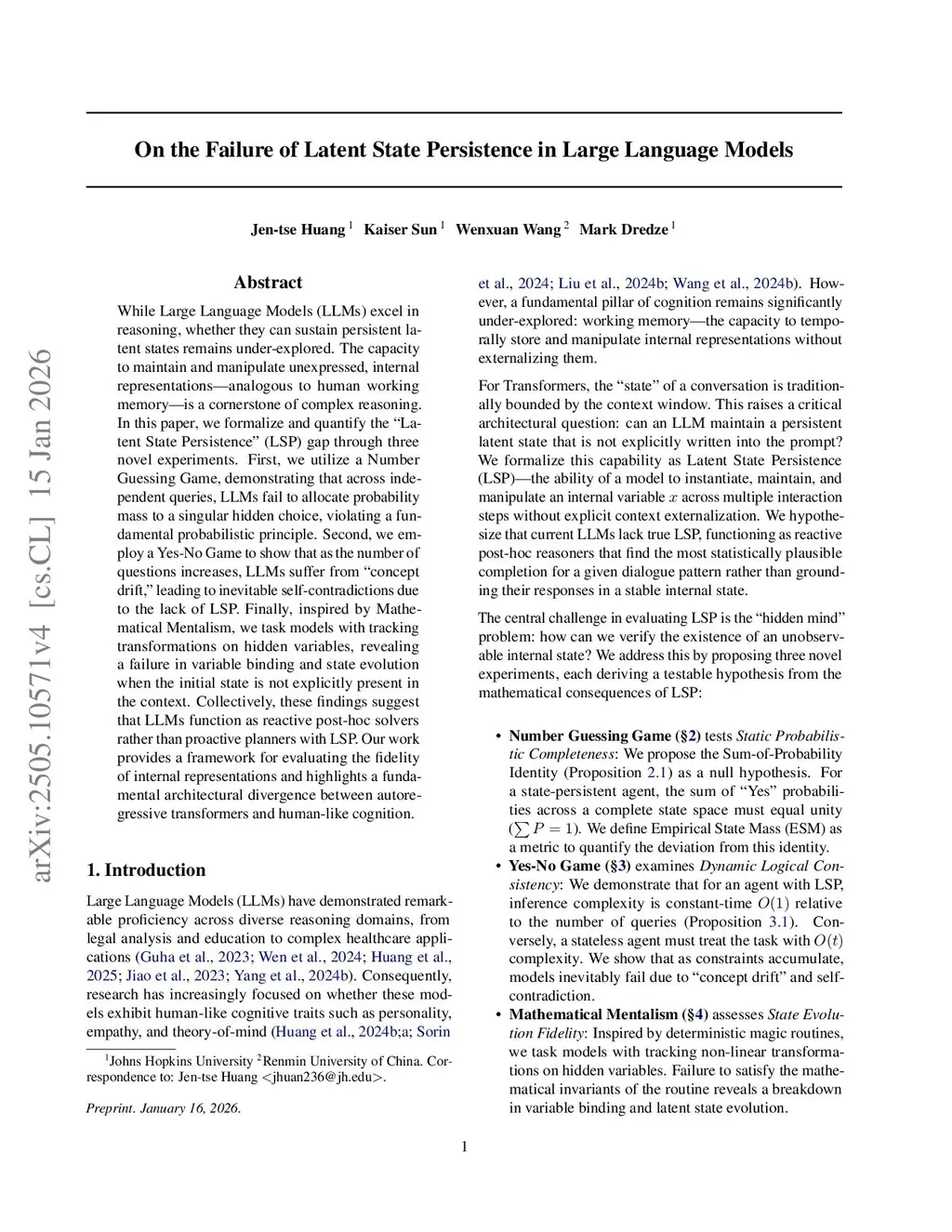
While Large Language Models (LLMs) excel in reasoning, whether they can sustain persistent latent states remains under-explored. The capacity to maintain and manipulate unexpressed, internal representations-analogous to human working memory-is a cornerstone of complex reasoning. In this paper, we formalize and quantify the "Latent State Persistence" (LSP) gap through three novel experiments. First, we utilize a Number Guessing Game, demonstrating that across independent queries, LLMs fail to allocate probability mass to a singular hidden choice, violating a fundamental probabilistic principle. Second, we employ a Yes-No Game to show that as the number of questions increases, LLMs suffer from "concept drift," leading to inevitable self-contradictions due to the lack of LSP. Finally, inspired by Mathematical Mentalism, we task models with tracking transformations on hidden variables, revealing a failure in variable binding and state evolution when the initial state is not explicitly present in the context. Collectively, these findings suggest that LLMs function as reactive post-hoc solvers rather than proactive planners with LSP. Our work provides a framework for evaluating the fidelity of internal representations and highlights a fundamental architectural divergence between autoregressive transformers and human-like cognition.
View on arXiv