
Learning on a Razor's Edge: Identifiability and Singularity of Polynomial Neural Networks
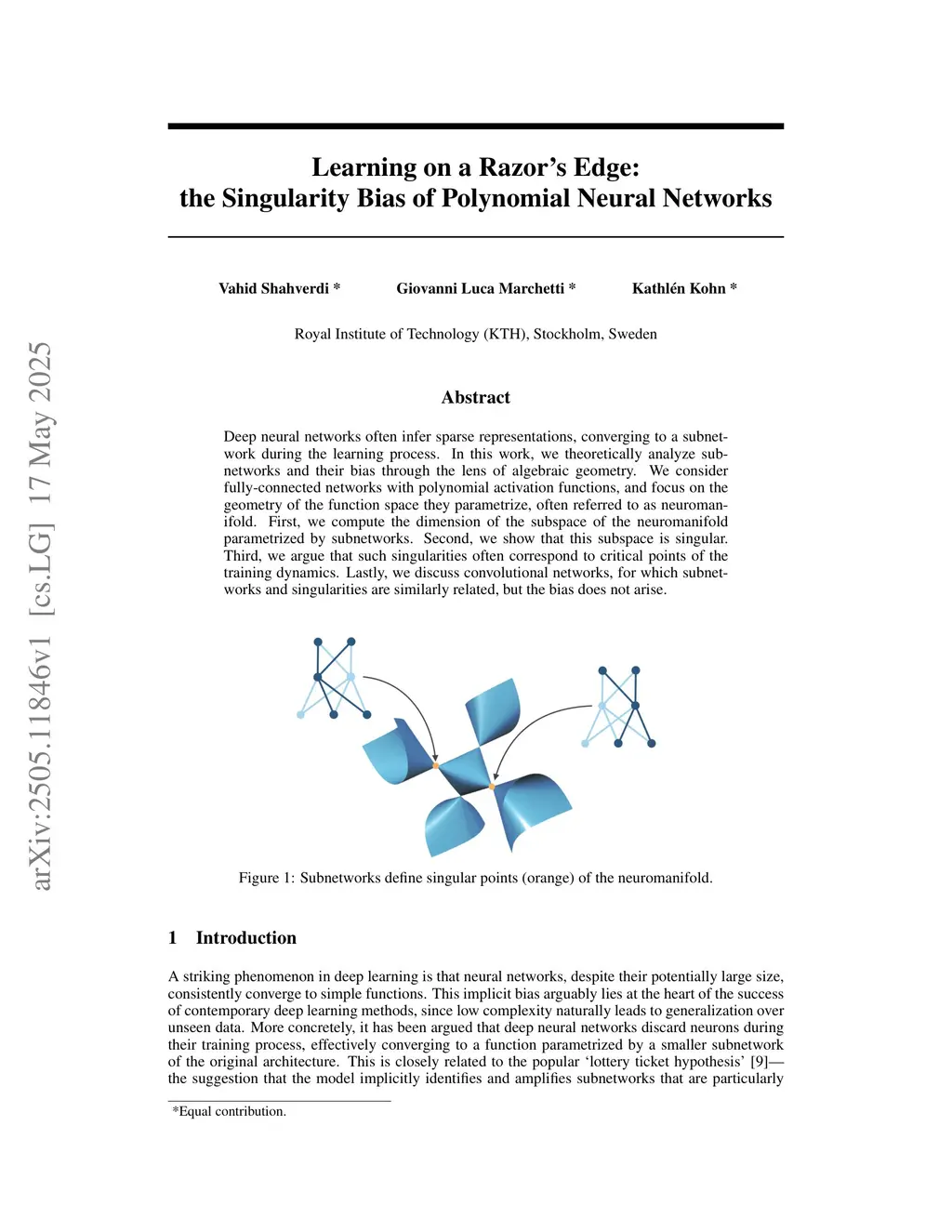
We study function spaces parametrized by neural networks, referred to as neuromanifolds. Specifically, we focus on deep Multi-Layer Perceptrons (MLPs) and Convolutional Neural Networks (CNNs) with an activation function that is a sufficiently generic polynomial. First, we address the identifiability problem, showing that, for almost all functions in the neuromanifold of an MLP, there exist only finitely many parameter choices yielding that function. For CNNs, the parametrization is generically one-to-one. As a consequence, we compute the dimension of the neuromanifold. Second, we describe singular points of neuromanifolds. We characterize singularities completely for CNNs, and partially for MLPs. In both cases, they arise from sparse subnetworks. For MLPs, we prove that these singularities often correspond to critical points of the mean-squared error loss, which does not hold for CNNs. This provides a geometric explanation of the sparsity bias of MLPs. All of our results leverage tools from algebraic geometry.
View on arXiv