
Fast and Simple Densest Subgraph with Predictions
- GNN
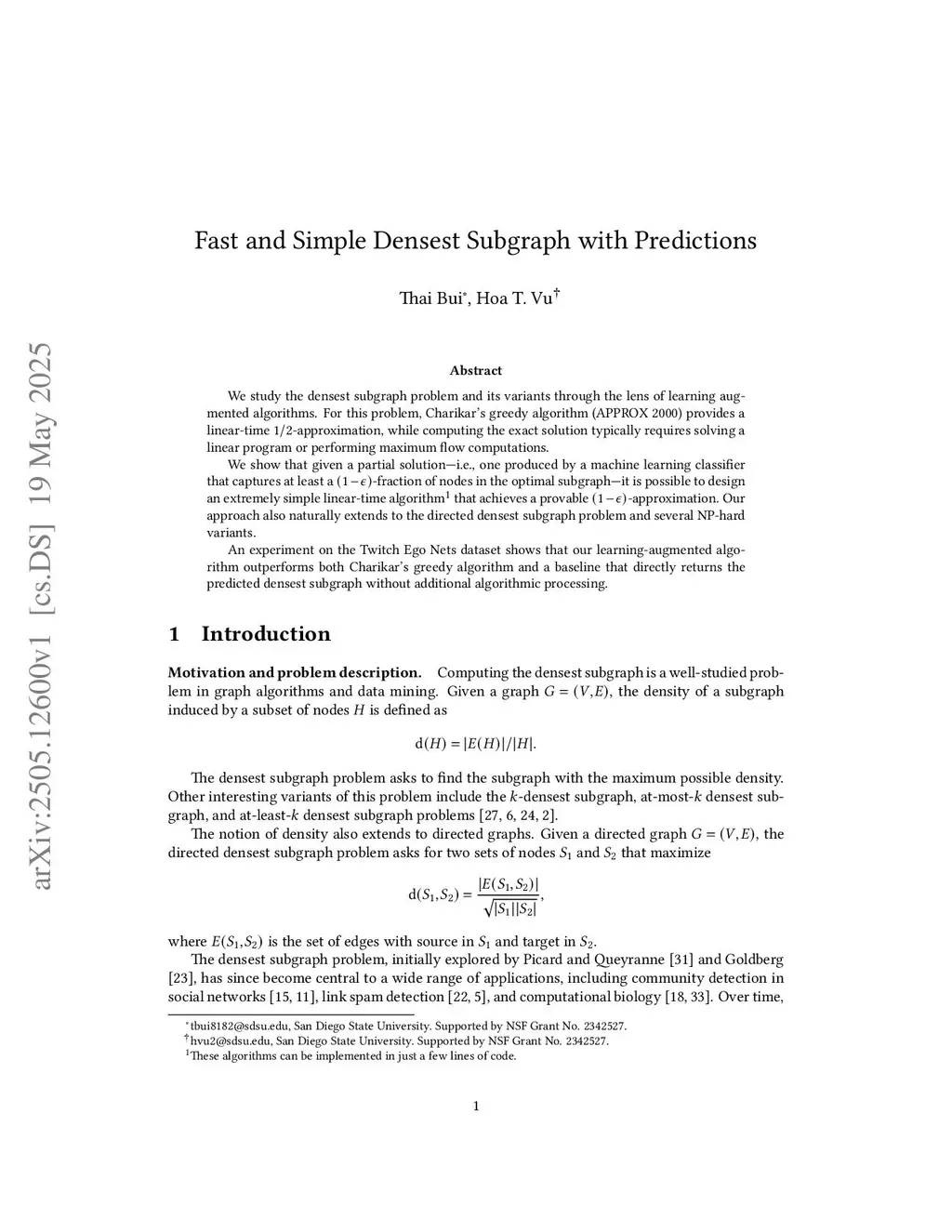
We study the densest subgraph problem and its variants through the lens of learning-augmented algorithms. For this problem, the greedy algorithm by Charikar (APPROX 2000) provides a linear-time $ 1/2 $-approximation, while computing the exact solution typically requires solving a linear program or performing maximum flow this http URL show that given a partial solution, i.e., one produced by a machine learning classifier that captures at least a $ (1 - \epsilon) $-fraction of nodes in the optimal subgraph, it is possible to design an extremely simple linear-time algorithm that achieves a provable $ (1 - \epsilon) $-approximation. Our approach also naturally extends to the directed densest subgraph problem and several NP-hard this http URL experiment on the Twitch Ego Nets dataset shows that our learning-augmented algorithm outperforms Charikar's greedy algorithm and a baseline that directly returns the predicted densest subgraph without additional algorithmic processing.
View on arXiv