
New Encoders for German Trained from Scratch: Comparing ModernGBERT with Converted LLM2Vec Models
- OffRL
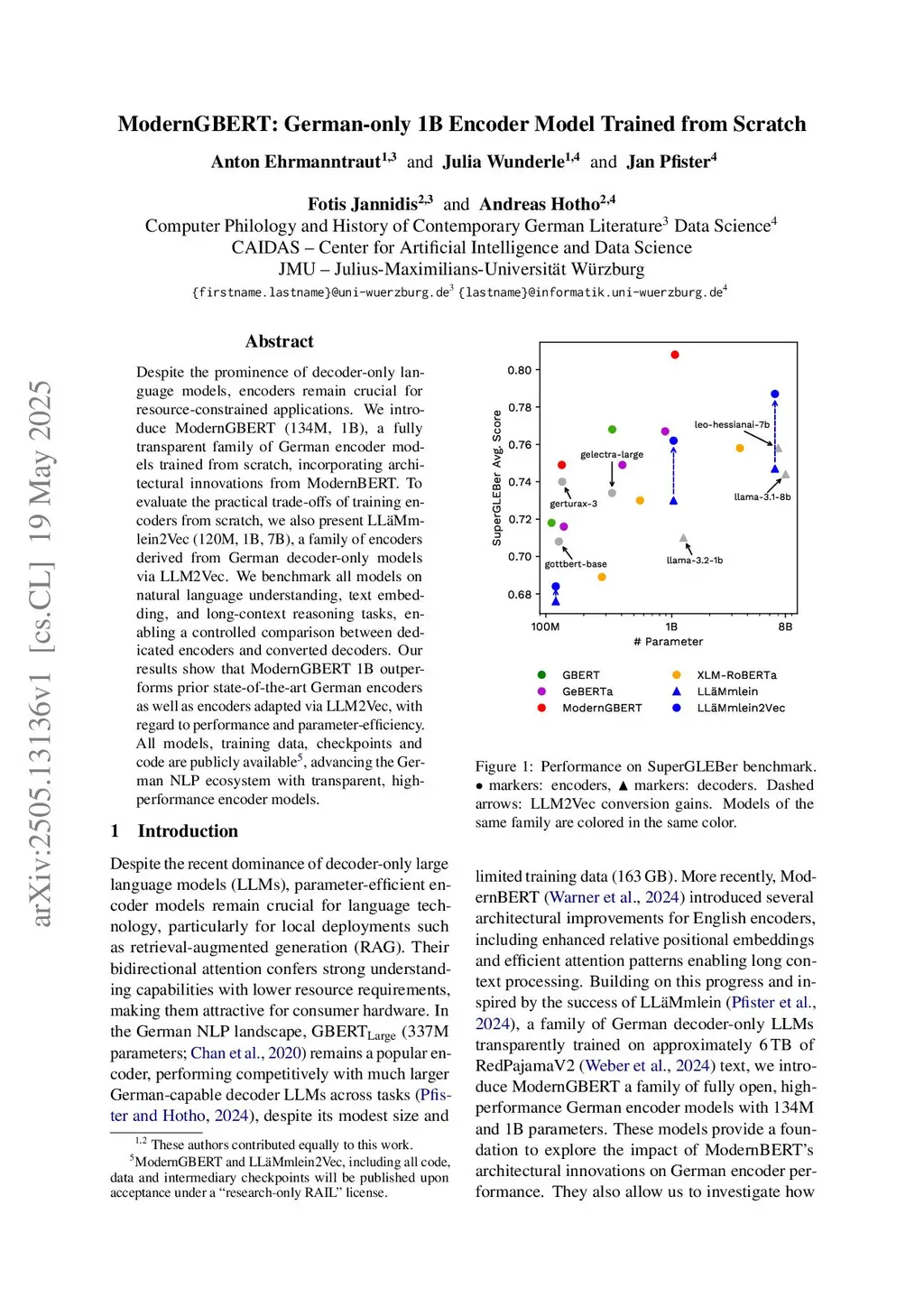
Encoders remain essential for efficient German NLP and NLU scenarios despite the rise of decoder-only LLMs. This work studies two routes to high-quality German encoders under identical data and training constraints: 1) training from scratch and 2) converting decoders via LLM2Vec. We introduce two resources: ModernGBERT (134M, 1B), fully transparent German encoders in the ModernBERT style, and LLäMmleinVec (120M, 1B, 7B), decoder-to-encoder conversions trained with masked next-token prediction, both undergoing a context extension to 8.192 tokens.Across SuperGLEBer, ModernGBERT 1B sets a new state of the art (avg 0.808), surpassing GBERT Large (+4%) and the seven-times larger converted 7B model (0.787). On German MTEB after supervised fine-tuning, ModernGBERT 1B (0.551) approaches the converted 7B model (0.557).We release all models, checkpoints, datasets, and full training records, and introduce an encoder-adapted QA-NIAH evaluation. All in all, our results provide actionable guidance: when parameter efficiency and latency matter, from-scratch encoders dominate. When a pre-trained decoder exists and compute is a limited, conversion offers an effective alternative. ModernGBERT and LLäMmleinVec, including all code, data and intermediary checkpoints are published under a research-only RAIL license.
View on arXiv