
Checkpoint-GCG: Auditing and Attacking Fine-Tuning-Based Prompt Injection Defenses
- AAML
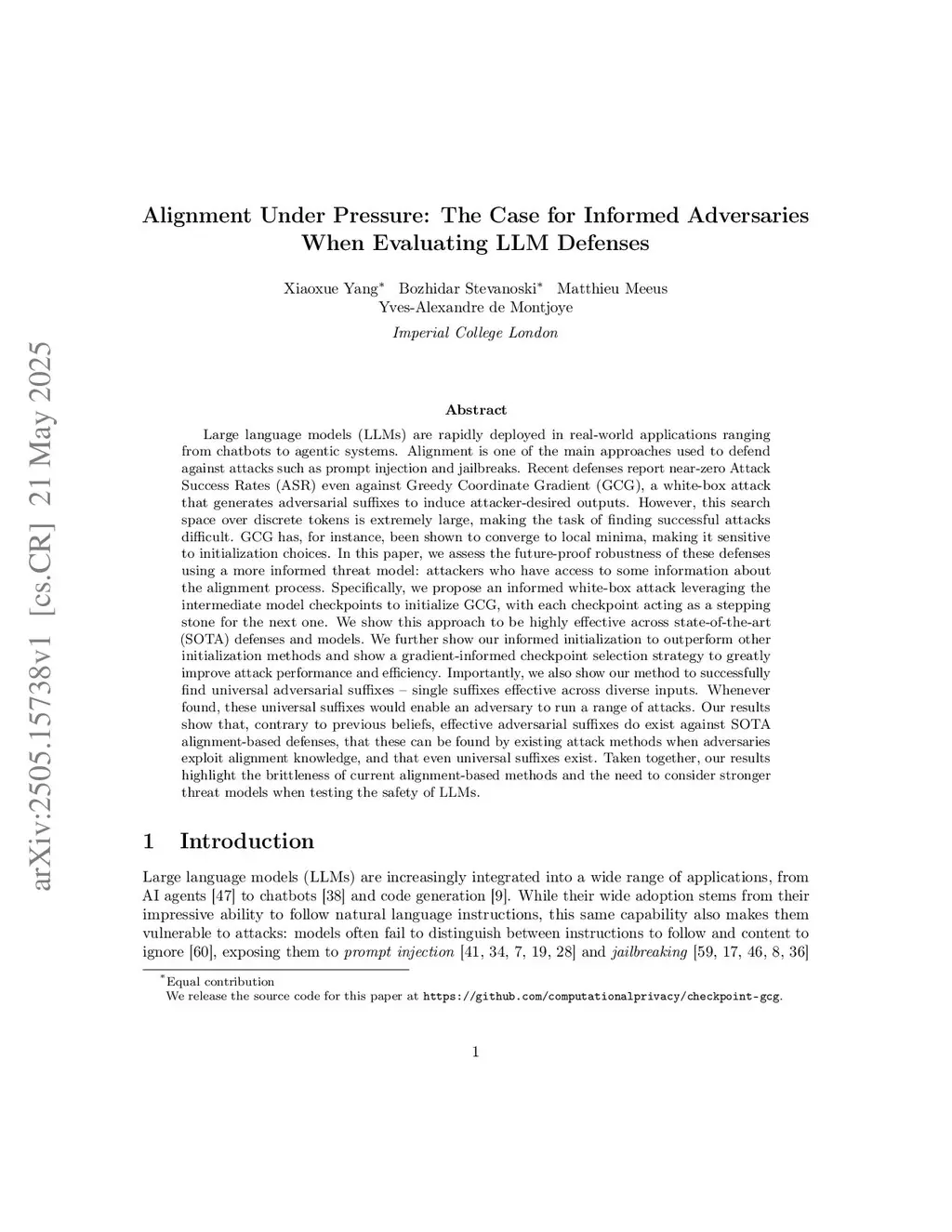
Large language models (LLMs) are increasingly deployed in real-world applications ranging from chatbots to agentic systems, where they are expected to process untrusted data and follow trusted instructions. Failure to distinguish between the two poses significant security risks, exploited by prompt injection attacks, which inject malicious instructions into the data to control model outputs. Model-level defenses have been proposed to mitigate prompt injection attacks. These defenses fine-tune LLMs to ignore injected instructions in untrusted data. We introduce Checkpoint-GCG, a white-box attack against fine-tuning-based defenses. Checkpoint-GCG enhances the Greedy Coordinate Gradient (GCG) attack by leveraging intermediate model checkpoints produced during fine-tuning to initialize GCG, with each checkpoint acting as a stepping stone for the next one to continuously improve attacks. First, we instantiate Checkpoint-GCG to evaluate the robustness of the state-of-the-art defenses in an auditing setup, assuming both (a) full knowledge of the model input and (b) access to intermediate model checkpoints. We show Checkpoint-GCG to achieve up to attack success rate (ASR) against the strongest defense. Second, we relax the first assumption by searching for a universal suffix that would work on unseen inputs, and obtain up to ASR against the strongest defense. Finally, we relax both assumptions by searching for a universal suffix that would transfer to similar black-box models and defenses, achieving an ASR of against a newly released defended model from Meta.
View on arXiv