
A Japanese Language Model and Three New Evaluation Benchmarks for Pharmaceutical NLP
- ELM
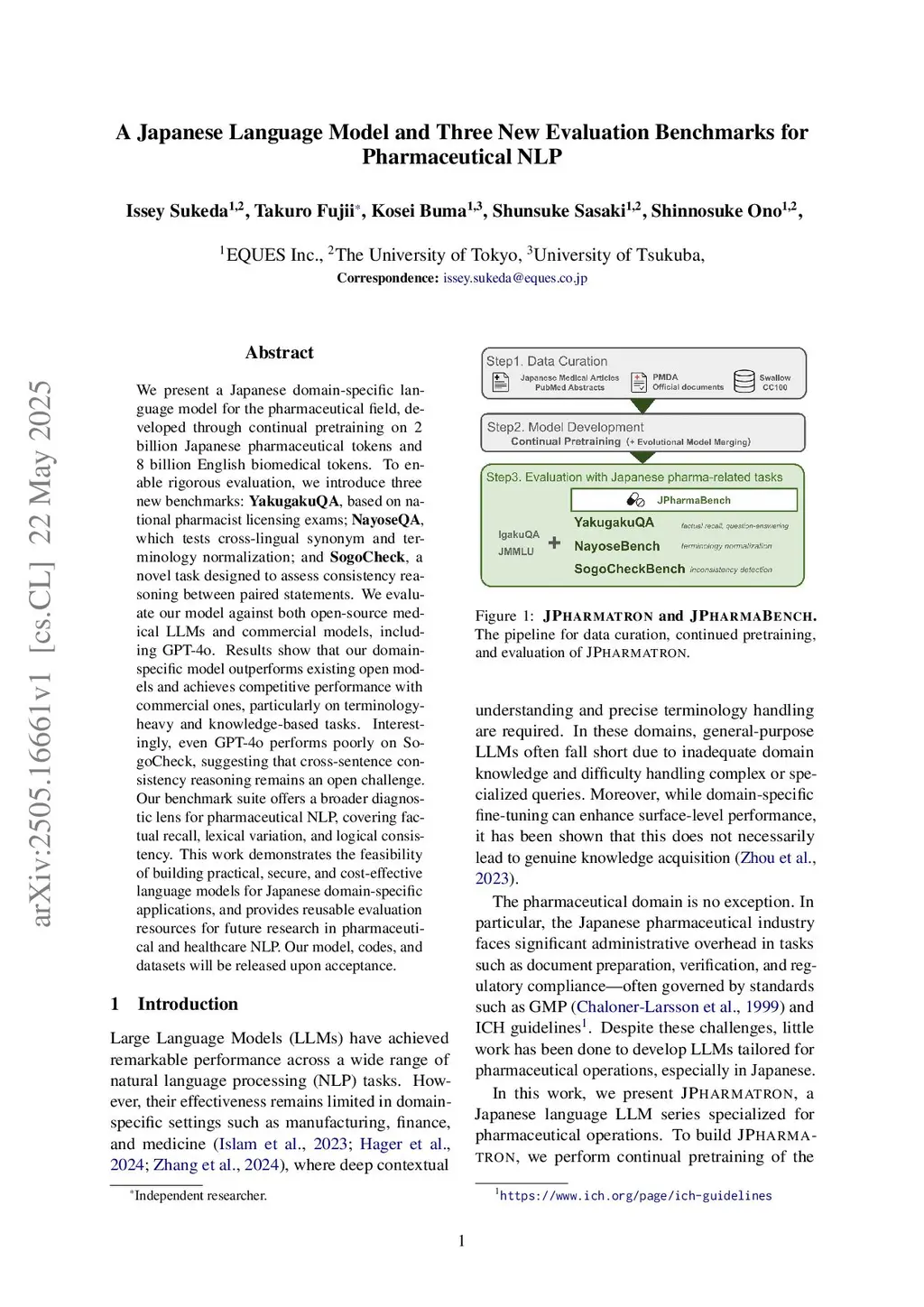
We present a Japanese domain-specific language model for the pharmaceutical field, developed through continual pretraining on 2 billion Japanese pharmaceutical tokens and 8 billion English biomedical tokens. To enable rigorous evaluation, we introduce three new benchmarks: YakugakuQA, based on national pharmacist licensing exams; NayoseQA, which tests cross-lingual synonym and terminology normalization; and SogoCheck, a novel task designed to assess consistency reasoning between paired statements. We evaluate our model against both open-source medical LLMs and commercial models, including GPT-4o. Results show that our domain-specific model outperforms existing open models and achieves competitive performance with commercial ones, particularly on terminology-heavy and knowledge-based tasks. Interestingly, even GPT-4o performs poorly on SogoCheck, suggesting that cross-sentence consistency reasoning remains an open challenge. Our benchmark suite offers a broader diagnostic lens for pharmaceutical NLP, covering factual recall, lexical variation, and logical consistency. This work demonstrates the feasibility of building practical, secure, and cost-effective language models for Japanese domain-specific applications, and provides reusable evaluation resources for future research in pharmaceutical and healthcare NLP. Our model, codes, and datasets are released atthis https URL.
View on arXiv