
LISRec: Modeling User Preferences with Learned Item Shortcuts for Sequential Recommendation
- HAI
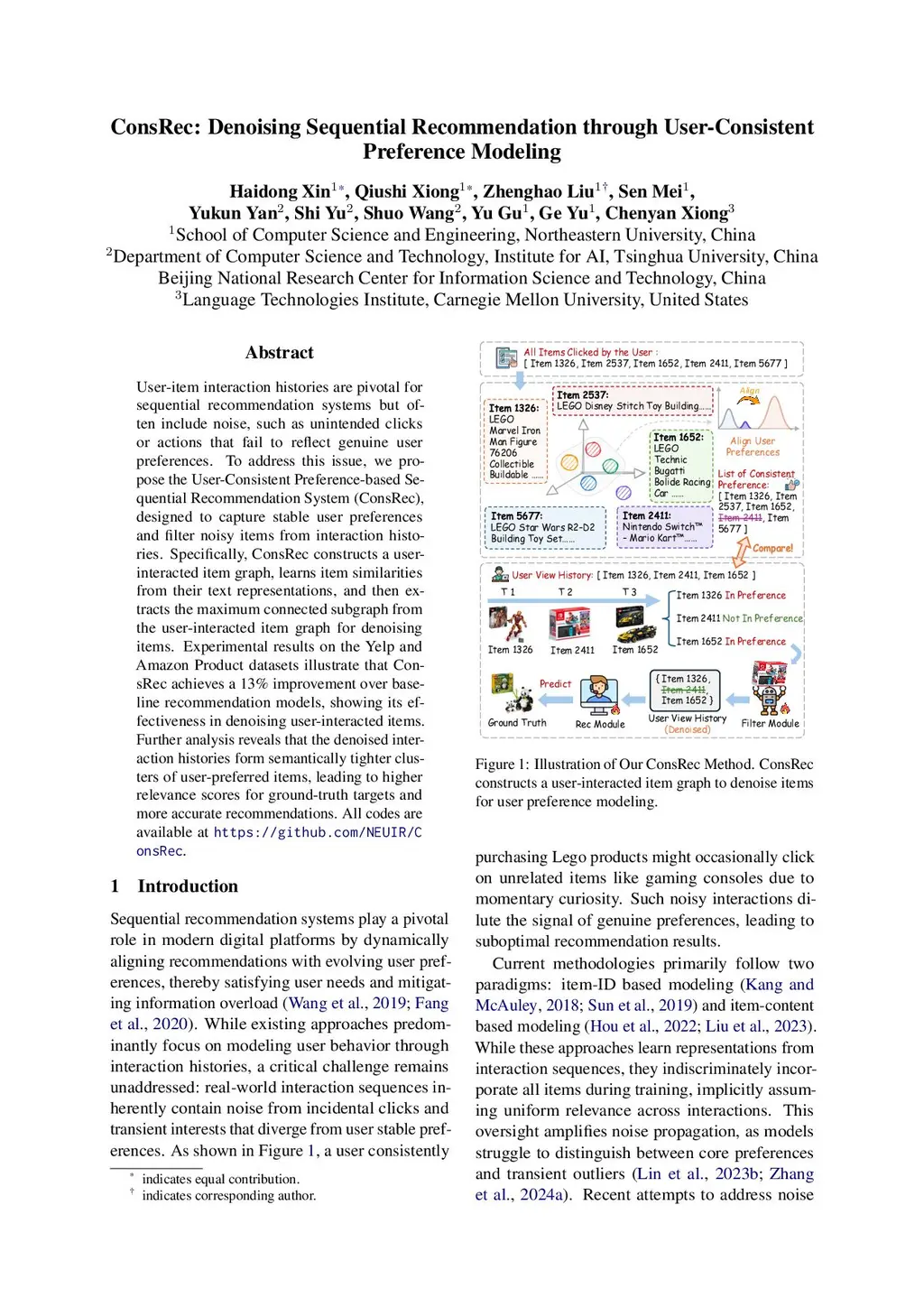
User-item interaction histories are pivotal for sequential recommendation systems but often include noise, such as unintended clicks or actions that fail to reflect genuine user preferences. To address this, we propose Learned Item Shortcuts for Sequential Recommendation (LISRec), a novel framework that explicitly captures stable preferences by extracting personalized semantic shortcuts from historical interactions. LISRec first learns task-agnostic semantic representations to assess item similarities, then constructs a personalized semantic graph over all user-interacted items. By identifying the maximal semantic connectivity subset within this graph, LISRec selects the most representative items as semantic shortcuts to guide user preference modeling. This focused representation filters out irrelevant actions while preserving the diversity of genuine interests. Experimental results on the Yelp and Amazon Product datasets illustrate that LISRec achieves a 13% improvement over baseline recommendation models, showing its effectiveness in capturing stable user interests. Further analysis indicates that shortcut-based histories better capture user preferences, making more accurate and relevant recommendations. All codes and datasets are available atthis https URL.
View on arXiv