
Recasting Classical Motion Planning for Contact-Rich Manipulation
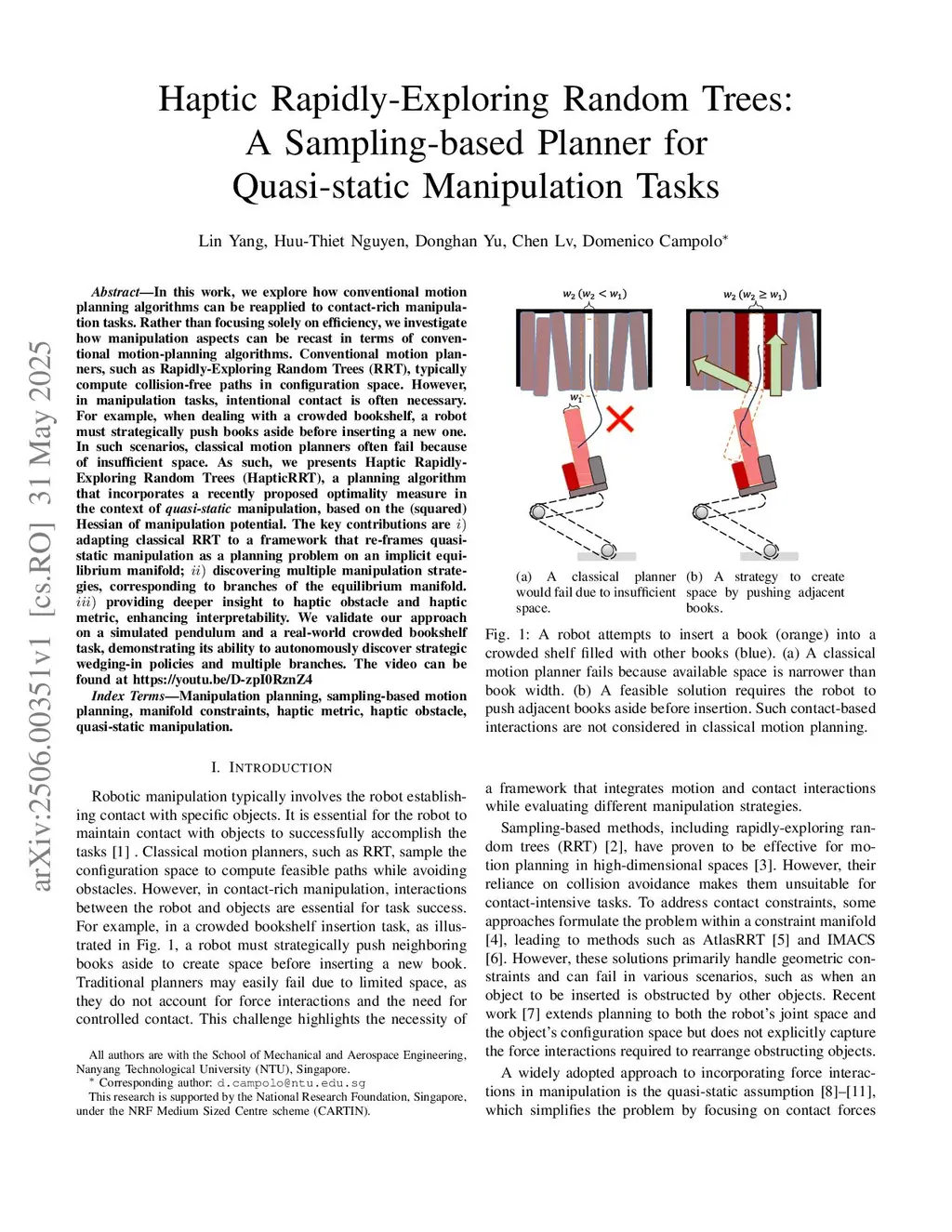
In this work, we explore how conventional motion planning algorithms can be reapplied to contact-rich manipulation tasks. Rather than focusing solely on efficiency, we investigate how manipulation aspects can be recast in terms of conventional motion-planning algorithms. Conventional motion planners, such as Rapidly-Exploring Random Trees (RRT), typically compute collision-free paths in configuration space. However, in many manipulation tasks, contact is either unavoidable or essential for task success, such as for creating space or maintaining physical equilibrium. As such, we presents Haptic Rapidly-Exploring Random Trees (HapticRRT), a planning algorithm that incorporates a recently proposed optimality measure in the context of \textit{quasi-static} manipulation, based on the (squared) Hessian of manipulation potential. The key contributions are i) adapting classical RRT to operate on the quasi-static equilibrium manifold, while deepening the interpretation of haptic obstacles and metrics; ii) discovering multiple manipulation strategies, corresponding to branches of the equilibrium manifold. iii) validating the generality of our method across three diverse manipulation tasks, each requiring only a single manipulation potential expression. The video can be found atthis https URL.
View on arXiv