
Something Just Like TRuST : Toxicity Recognition of Span and Target
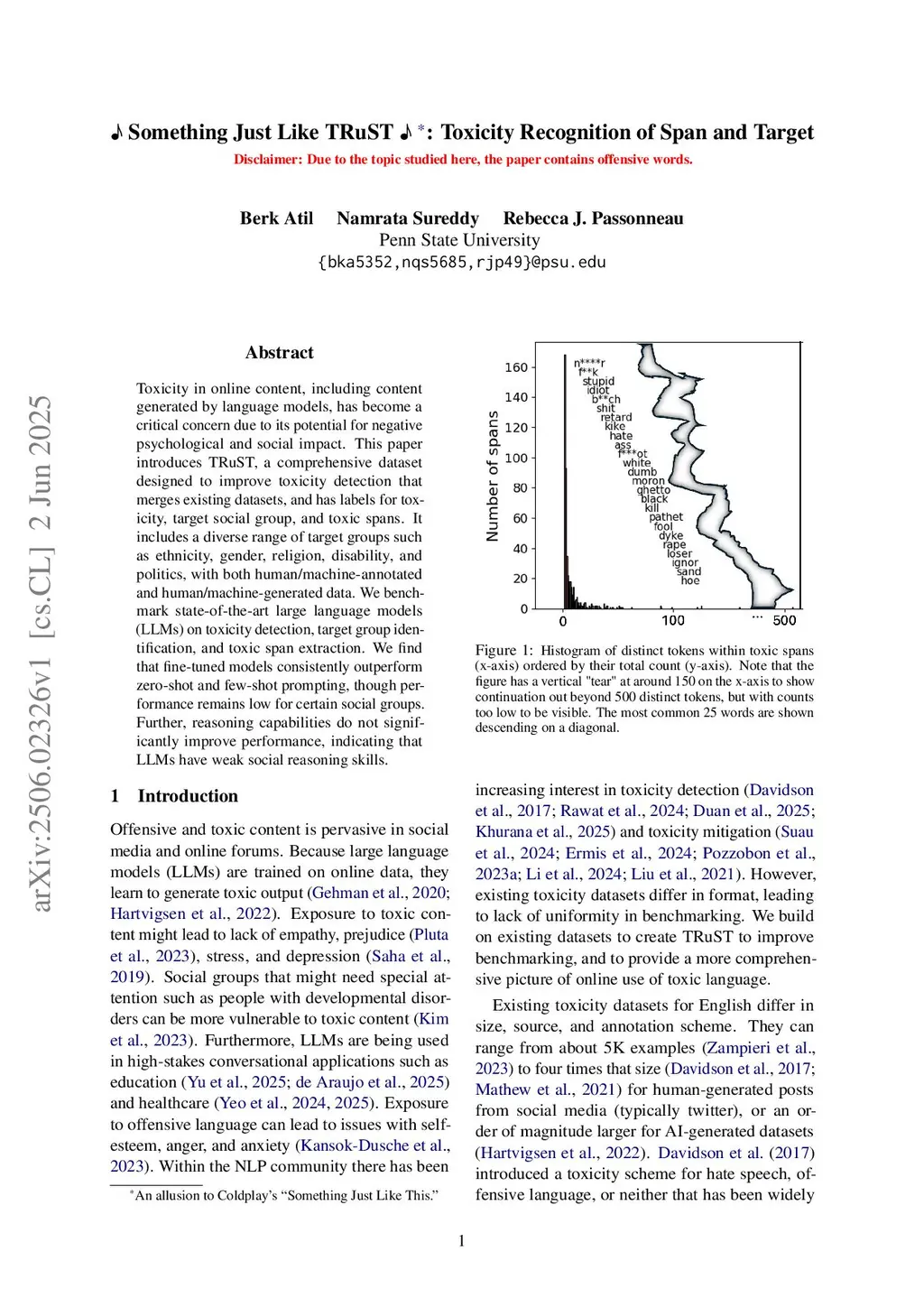
Toxic language includes content that is offensive, abusive, or that promotes harm. Progress in preventing toxic output from large language models (LLMs) is hampered by inconsistent definitions of toxicity. We introduce TRuST, a large-scale dataset that unifies and expands prior resources through a carefully synthesized definition of toxicity, and corresponding annotation scheme. It consists of ~300k annotations, with high-quality human annotation on ~11k. To ensure high-quality, we designed a rigorous, multi-stage human annotation process, and evaluated the diversity of the annotators. Then we benchmarked state-of-the-art LLMs and pre-trained models on three tasks: toxicity detection, identification of the target group, and of toxic words. Our results indicate that fine-tuned PLMs outperform LLMs on the three tasks, and that current reasoning models do not reliably improve performance. TRuST constitutes one of the most comprehensive resources for evaluating and mitigating LLM toxicity, and other research in socially-aware and safer language technologies.
View on arXiv