
Flexiffusion: Training-Free Segment-Wise Neural Architecture Search for Efficient Diffusion Models
- MedIm
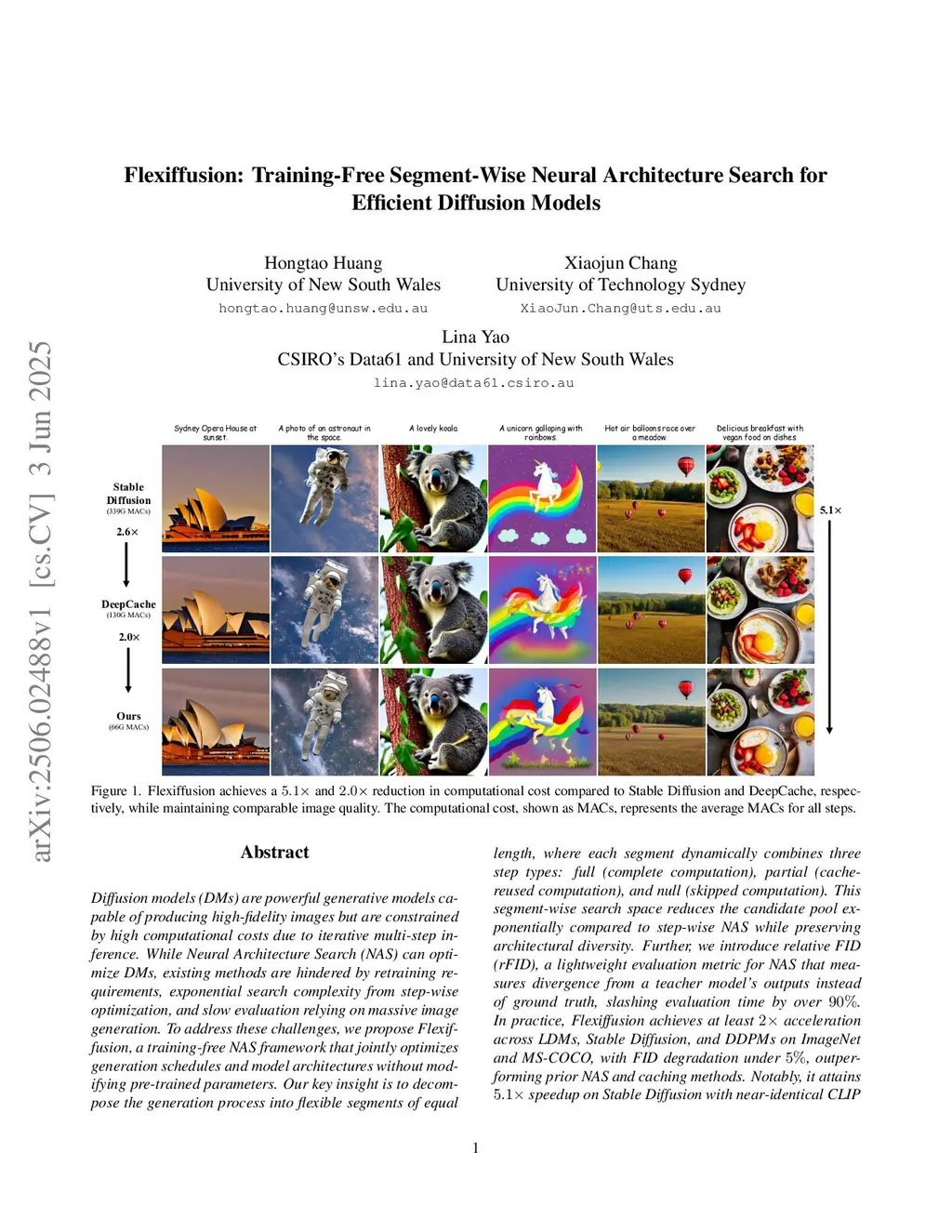
Diffusion models (DMs) are powerful generative models capable of producing high-fidelity images but are constrained by high computational costs due to iterative multi-step inference. While Neural Architecture Search (NAS) can optimize DMs, existing methods are hindered by retraining requirements, exponential search complexity from step-wise optimization, and slow evaluation relying on massive image generation. To address these challenges, we propose Flexiffusion, a training-free NAS framework that jointly optimizes generation schedules and model architectures without modifying pre-trained parameters. Our key insight is to decompose the generation process into flexible segments of equal length, where each segment dynamically combines three step types: full (complete computation), partial (cache-reused computation), and null (skipped computation). This segment-wise search space reduces the candidate pool exponentially compared to step-wise NAS while preserving architectural diversity. Further, we introduce relative FID (rFID), a lightweight evaluation metric for NAS that measures divergence from a teacher model's outputs instead of ground truth, slashing evaluation time by over . In practice, Flexiffusion achieves at least acceleration across LDMs, Stable Diffusion, and DDPMs on ImageNet and MS-COCO, with FID degradation under , outperforming prior NAS and caching methods. Notably, it attains speedup on Stable Diffusion with near-identical CLIP scores. Our work pioneers a resource-efficient paradigm for searching high-speed DMs without sacrificing quality.
View on arXiv