
EmbedAgent: Benchmarking Large Language Models in Embedded System Development
- RALM
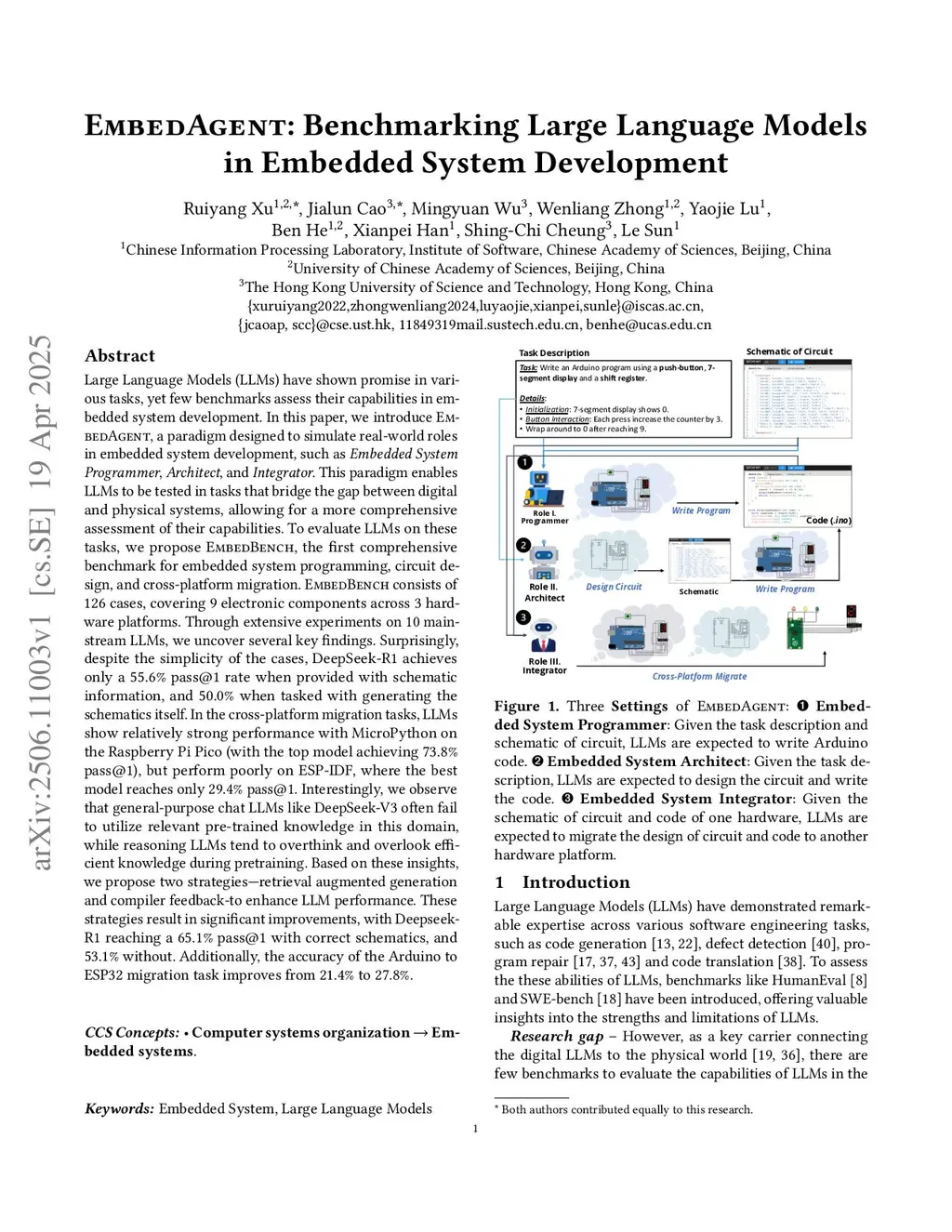
Large Language Models (LLMs) have shown promise in various tasks, yet few benchmarks assess their capabilities in embedded system development. In this paper, we introduce EmbedAgent, a paradigm designed to simulate real-world roles in embedded system development, such as Embedded System Programmer, Architect, and Integrator. This paradigm enables LLMs to be tested in tasks that bridge the gap between digital and physical systems, allowing for a more comprehensive assessment of their capabilities. To evaluate LLMs on these tasks, we propose Embedbench, the first comprehensive benchmark for embedded system programming, circuit design, and cross-platform migration. Embedbench consists of 126 cases, covering 9 electronic components across 3 hardware platforms. Through extensive experiments on 10 mainstream LLMs, we uncover several key findings. Surprisingly, despite the simplicity of the cases, DeepSeek-R1 achieves only a 55.6% pass@1 rate when provided with schematic information, and 50.0% when tasked with generating the schematics itself. In the cross-platform migration tasks, LLMs show relatively strong performance with MicroPython on the Raspberry Pi Pico (with the top model achieving 73.8% pass@1), but perform poorly on ESP-IDF, where the best model reaches only 29.4% pass@1. Interestingly, we observe that general-purpose chat LLMs like DeepSeek-V3 often fail to utilize relevant pre-trained knowledge in this domain, while reasoning LLMs tend to overthink and overlook efficient knowledge during pretraining. Based on these insights, we propose two strategies: retrieval augmented generation and compiler feedback-to enhance LLM performance. These strategies result in significant improvements, with Deepseek-R1 reaching a 65.1% pass@1 with correct schematics, and 53.1% without. Additionally, the accuracy of the Arduino to ESP32 migration task improves from 21.4% to 27.8%.
View on arXiv