
GNSS-Inertial State Initialization Using Inter-Epoch Baseline Residuals
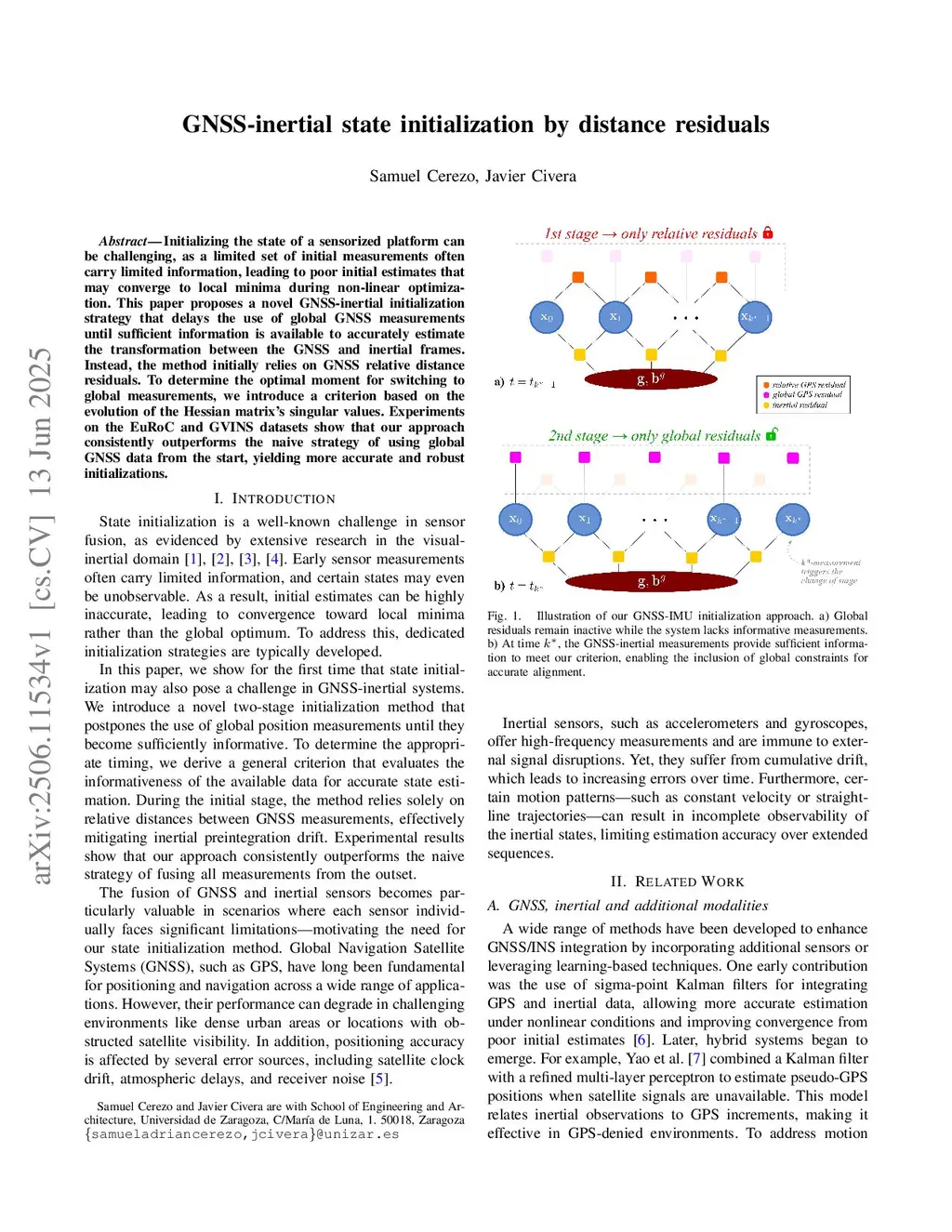
Initializing the state of a sensorized platform can be challenging, as a limited set of measurements often provide low-informative constraints that are in addition highly non-linear. This may lead to poor initial estimates that may converge to local minima during subsequent non-linear optimization. We propose an adaptive GNSS-inertial initialization strategy that delays the incorporation of global GNSS constraints until they become sufficiently informative. In the initial stage, our method leverages inter-epoch baseline vector residuals between consecutive GNSS fixes to mitigate inertial drift. To determine when to activate global constraints, we introduce a general criterion based on the evolution of the Hessian matrix's singular values, effectively quantifying system observability. Experiments on EuRoC, GVINS and MARS-LVIG datasets show that our approach consistently outperforms the naive strategy of fusing all measurements from the outset, yielding more accurate and robust initializations.
View on arXiv