
GroupNL: Low-Resource and Robust CNN Design over Cloud and Device
- OOD
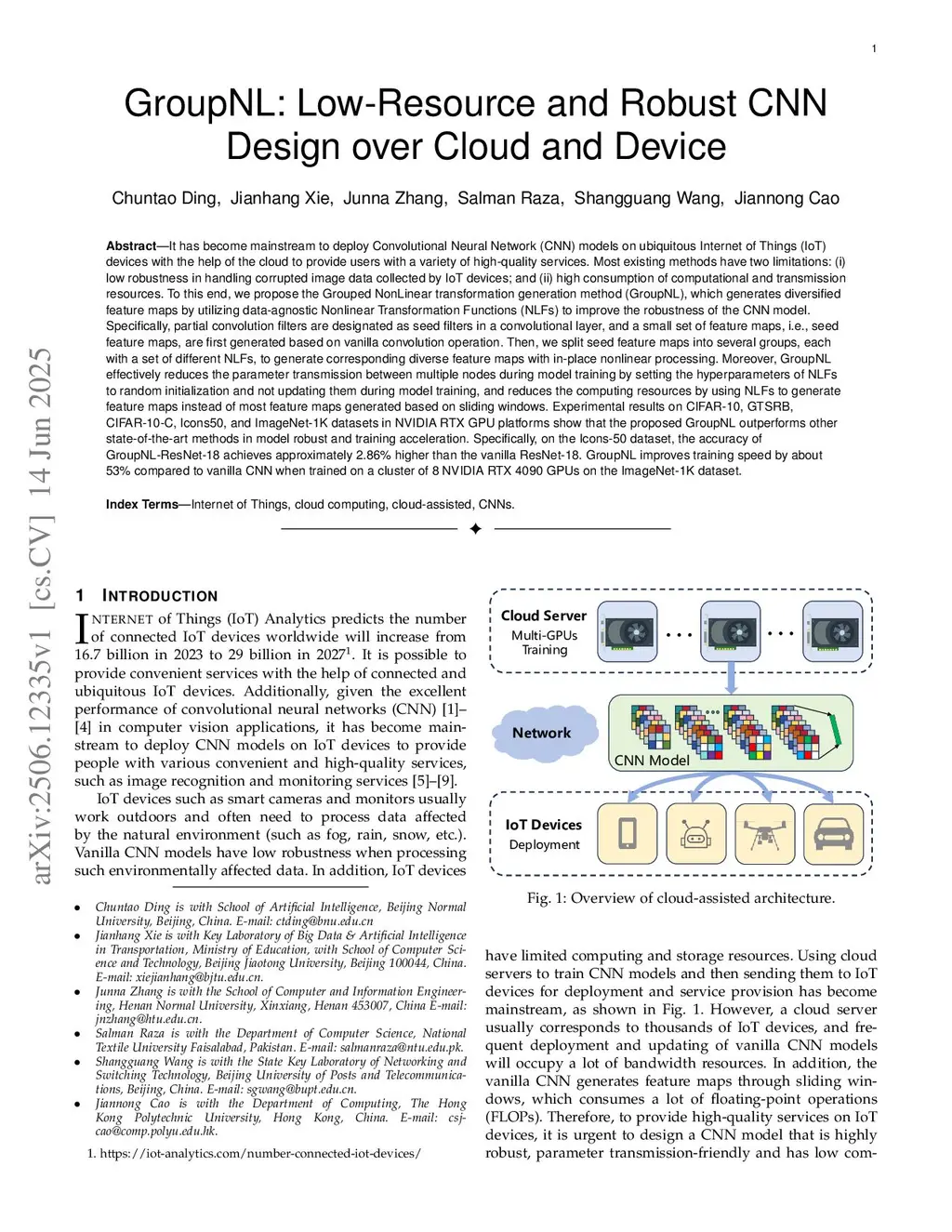
Deploying Convolutional Neural Network (CNN) models on ubiquitous Internet of Things (IoT) devices in a cloud-assisted manner to provide users with a variety of high-quality services has become mainstream. Most existing studies speed up model cloud training/on-device inference by reducing the number of convolution (Conv) parameters and floating-point operations (FLOPs). However, they usually employ two or more lightweight operations (e.g., depthwise Conv, cheap Conv) to replace a Conv, which can still affect the model's speedup even with fewer parameters and FLOPs. To this end, we propose the Grouped NonLinear transformation generation method (GroupNL), leveraging data-agnostic, hyperparameters-fixed, and lightweight Nonlinear Transformation Functions (NLFs) to generate diversified feature maps on demand via grouping, thereby reducing resource consumption while improving the robustness of CNNs. First, in a GroupNL Conv layer, a small set of feature maps, i.e., seed feature maps, are generated based on the seed Conv operation. Then, we split seed feature maps into several groups, each with a set of different NLFs, to generate the required number of diversified feature maps with tensor manipulation operators and nonlinear processing in a lightweight manner without additional Conv operations. We further introduce a sparse GroupNL Conv to speed up by reasonably designing the seed Conv groups between the number of input channels and seed feature maps. Experiments conducted on benchmarks and on-device resource measurements demonstrate that the GroupNL Conv is an impressive alternative to Conv layers in baseline models. Specifically, on Icons-50 dataset, the accuracy of GroupNL-ResNet-18 is 2.86% higher than ResNet-18; on ImageNet-C dataset, the accuracy of GroupNL-EfficientNet-ES achieves about 1.1% higher than EfficientNet-ES.
View on arXiv