
From Points to Places: Towards Human Mobility-Driven Spatiotemporal Foundation Models via Understanding Places
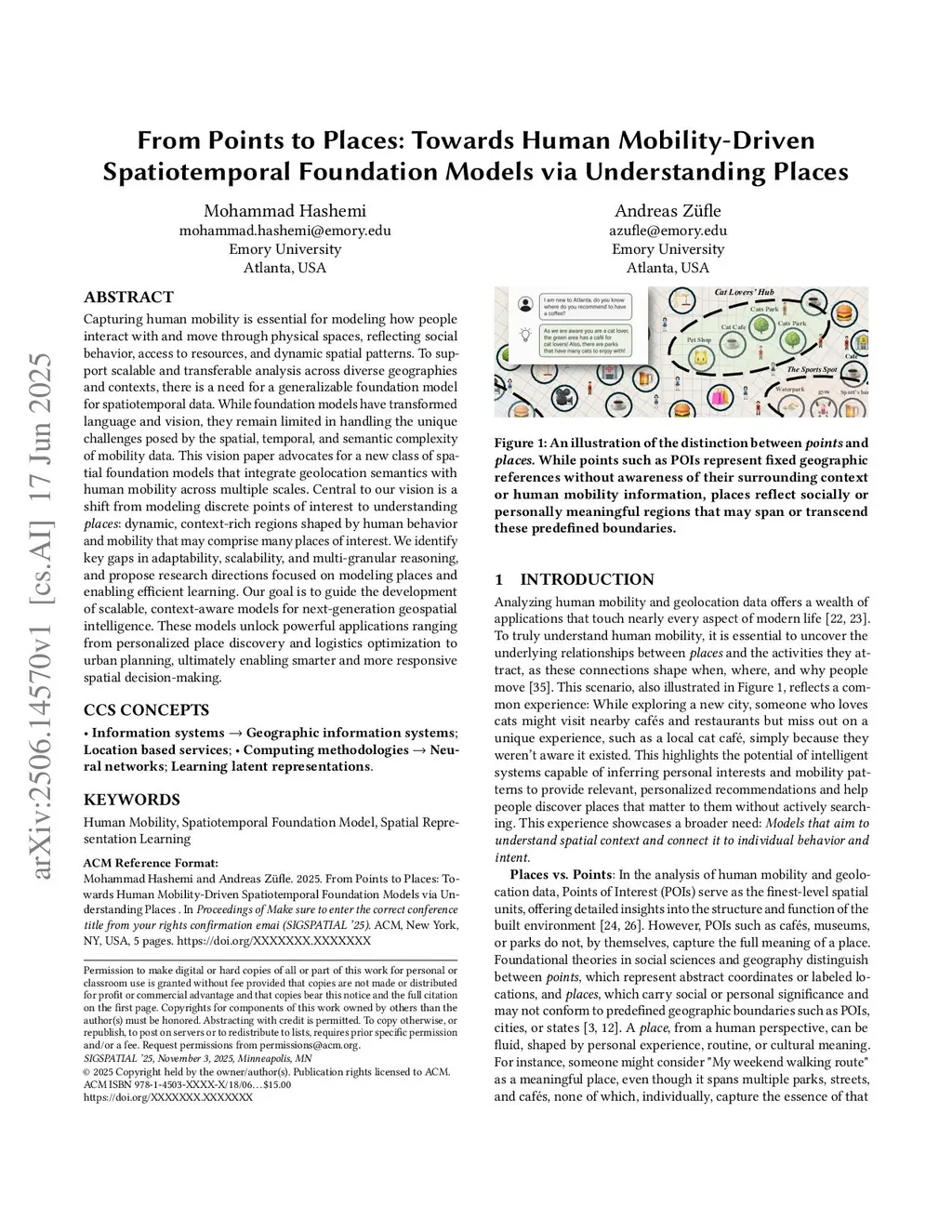
Capturing human mobility is essential for modeling how people interact with and move through physical spaces, reflecting social behavior, access to resources, and dynamic spatial patterns. To support scalable and transferable analysis across diverse geographies and contexts, there is a need for a generalizable foundation model for spatiotemporal data. While foundation models have transformed language and vision, they remain limited in handling the unique challenges posed by the spatial, temporal, and semantic complexity of mobility data. This vision paper advocates for a new class of spatial foundation models that integrate geolocation semantics with human mobility across multiple scales. Central to our vision is a shift from modeling discrete points of interest to understanding places: dynamic, context-rich regions shaped by human behavior and mobility that may comprise many places of interest. We identify key gaps in adaptability, scalability, and multi-granular reasoning, and propose research directions focused on modeling places and enabling efficient learning. Our goal is to guide the development of scalable, context-aware models for next-generation geospatial intelligence. These models unlock powerful applications ranging from personalized place discovery and logistics optimization to urban planning, ultimately enabling smarter and more responsive spatial decision-making.
View on arXiv