
Sign Spotting Disambiguation using Large Language Models
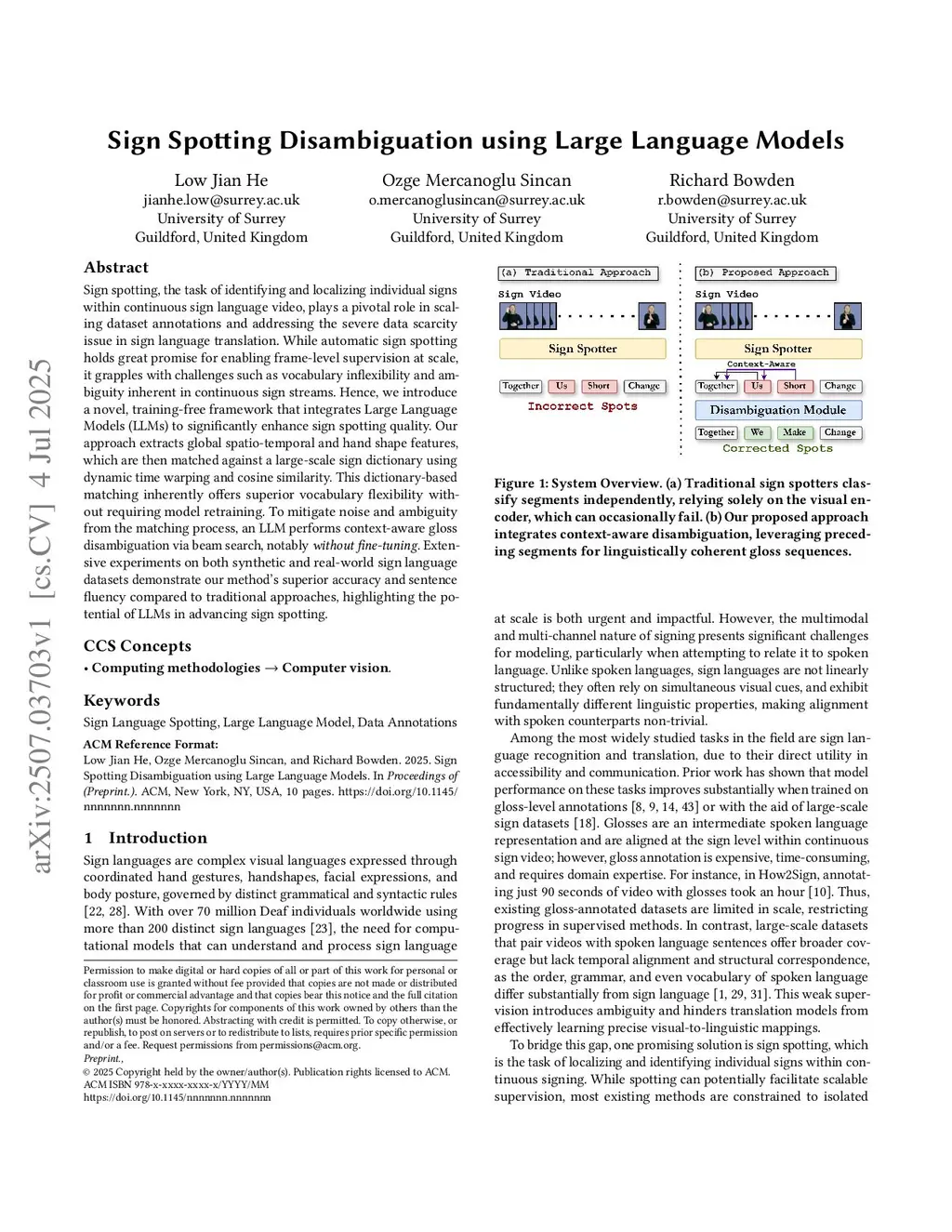
Sign spotting, the task of identifying and localizing individual signs within continuous sign language video, plays a pivotal role in scaling dataset annotations and addressing the severe data scarcity issue in sign language translation. While automatic sign spotting holds great promise for enabling frame-level supervision at scale, it grapples with challenges such as vocabulary inflexibility and ambiguity inherent in continuous sign streams. Hence, we introduce a novel, training-free framework that integrates Large Language Models (LLMs) to significantly enhance sign spotting quality. Our approach extracts global spatio-temporal and hand shape features, which are then matched against a large-scale sign dictionary using dynamic time warping and cosine similarity. This dictionary-based matching inherently offers superior vocabulary flexibility without requiring model retraining. To mitigate noise and ambiguity from the matching process, an LLM performs context-aware gloss disambiguation via beam search, notably without fine-tuning. Extensive experiments on both synthetic and real-world sign language datasets demonstrate our method's superior accuracy and sentence fluency compared to traditional approaches, highlighting the potential of LLMs in advancing sign spotting.
View on arXiv