
PASC-Net:Plug-and-play Shape Self-learning Convolutions Network with Hierarchical Topology Constraints for Vessel Segmentation
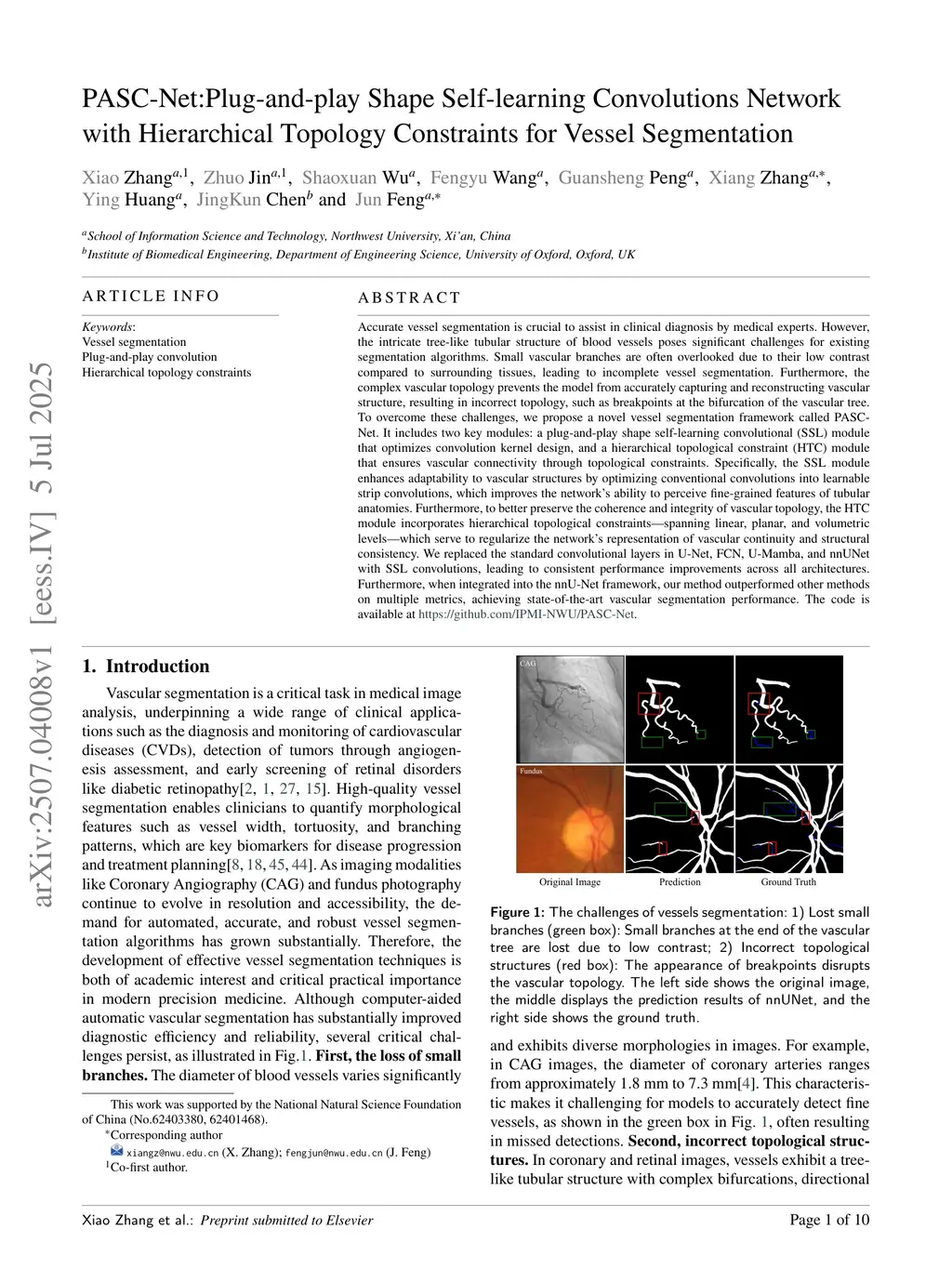
Accurate vessel segmentation is crucial to assist in clinical diagnosis by medical experts. However,the intricate tree-like tubular structure of blood vessels poses significant challenges for existingsegmentation algorithms. Small vascular branches are often overlooked due to their low contrastcompared to surrounding tissues, leading to incomplete vessel segmentation. Furthermore, thecomplex vascular topology prevents the model from accurately capturing and reconstructing vascularstructure, resulting in incorrect topology, such as breakpoints at the bifurcation of the vascular tree.To overcome these challenges, we propose a novel vessel segmentation framework called PASC Net. It includes two key modules: a plug-and-play shape self-learning convolutional (SSL) modulethat optimizes convolution kernel design, and a hierarchical topological constraint (HTC) modulethat ensures vascular connectivity through topological constraints. Specifically, the SSL moduleenhances adaptability to vascular structures by optimizing conventional convolutions into learnablestrip convolutions, which improves the network's ability to perceive fine-grained features of tubularanatomies. Furthermore, to better preserve the coherence and integrity of vascular topology, the HTCmodule incorporates hierarchical topological constraints-spanning linear, planar, and volumetriclevels-which serve to regularize the network's representation of vascular continuity and structuralconsistency. We replaced the standard convolutional layers in U-Net, FCN, U-Mamba, and nnUNetwith SSL convolutions, leading to consistent performance improvements across all architectures.Furthermore, when integrated into the nnUNet framework, our method outperformed other methodson multiple metrics, achieving state-of-the-art vascular segmentation performance.
View on arXiv