
Towards Spatially-Varying Gain and Binning
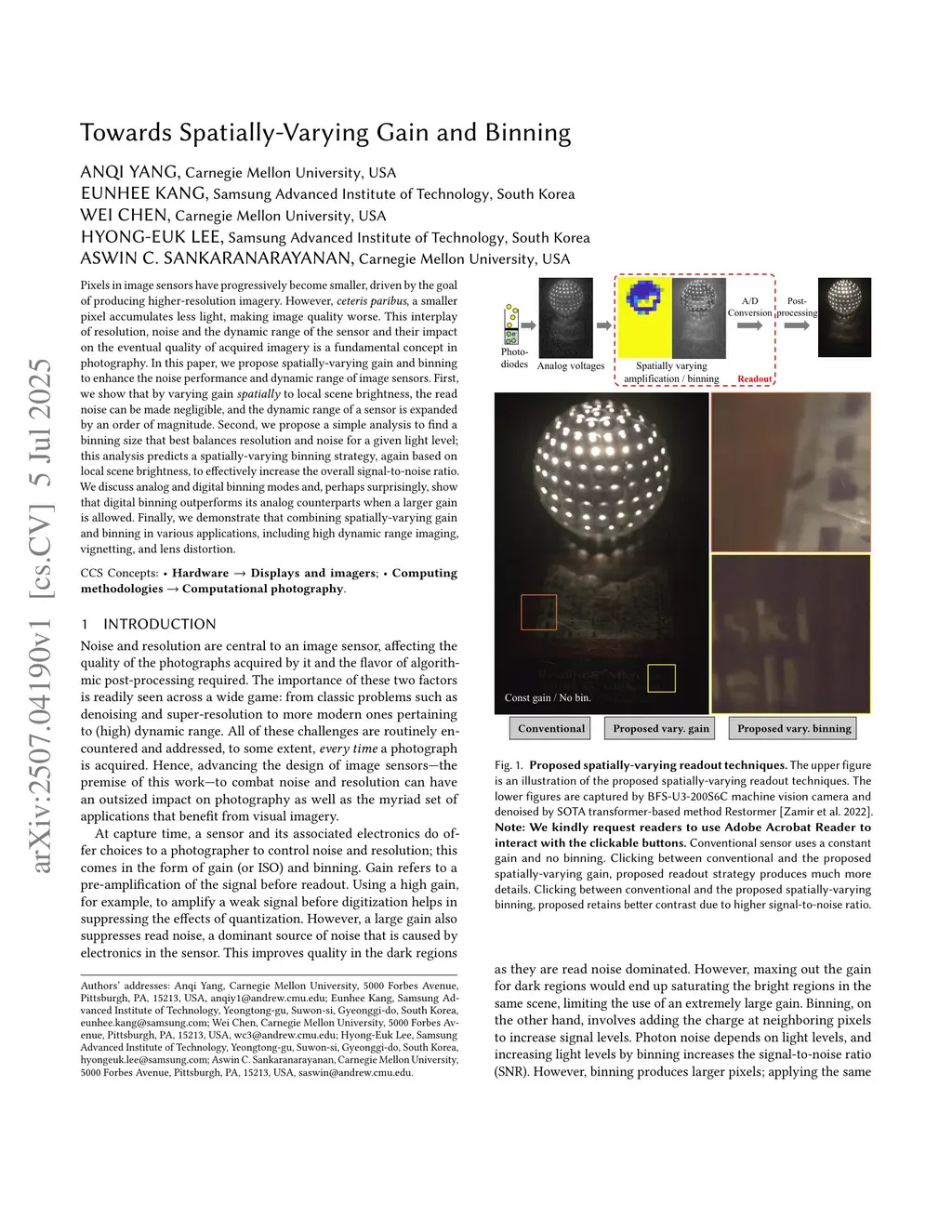
Pixels in image sensors have progressively become smaller, driven by the goal of producing higher-resolution imagery. However, ceteris paribus, a smaller pixel accumulates less light, making image quality worse. This interplay of resolution, noise, and the dynamic range of the sensor and their impact on the eventual quality of acquired imagery is a fundamental concept in photography. In this paper, we propose spatially-varying gain and binning to enhance the noise performance and dynamic range of image sensors. First, we show that by varying gain spatially to local scene brightness, the read noise can be made negligible, and the dynamic range of a sensor is expanded by an order of magnitude. Second, we propose a simple analysis to find a binning size that best balances resolution and noise for a given light level; this analysis predicts a spatially-varying binning strategy, again based on local scene brightness, to effectively increase the overall signal-to-noise ratio. % without sacrificing resolution. We discuss analog and digital binning modes and, perhaps surprisingly, show that digital binning outperforms its analog counterparts when a larger gain is allowed. Finally, we demonstrate that combining spatially-varying gain and binning in various applications, including high dynamic range imaging, vignetting, and lens distortion.
View on arXiv