
System Filter-Based Common Components Modeling for Cross-Subject EEG Decoding
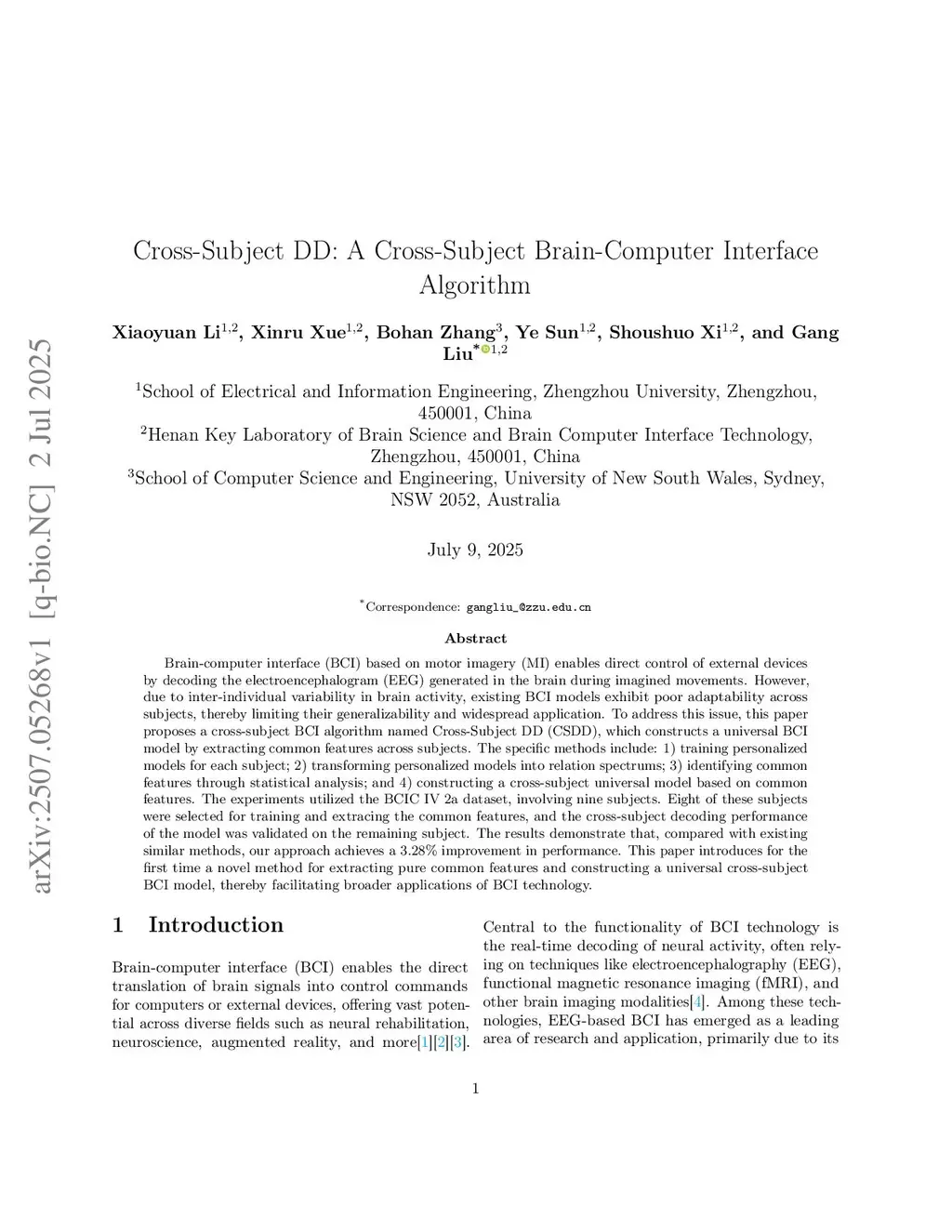
Brain-computer interface (BCI) technology enables direct communication between the brain and external devices through electroencephalography (EEG) signals. However, existing decoding models often mix common and personalized components, leading to interference from individual variability that limits cross-subject decoding performance. To address this issue, this paper proposes a system filter that extends the concept of signal filtering to the system level. The method expands a system into its spectral representation, selectively removes unnecessary components, and reconstructs the system from the retained target components, thereby achieving explicit system-level decomposition and filtering. We further integrate the system filter into a Cross-Subject Decoding framework based on the System Filter (CSD-SF) and evaluate it on the four-class motor imagery (MI) task of the BCIC IV 2a dataset. Personalized models are transformed into relation spectrums, and statistical testing across subjects is used to remove personalized components. The remaining stable relations, representing common components across subjects, are then used to construct a common model for cross-subject decoding. Experimental results show an average improvement of 3.28% in decoding accuracy over baseline methods, demonstrating that the proposed system filter effectively isolates stable common components and enhances model robustness and generalizability in cross-subject EEG decoding.
View on arXiv