
Capturing Stable HDR Videos Using a Dual-Camera System
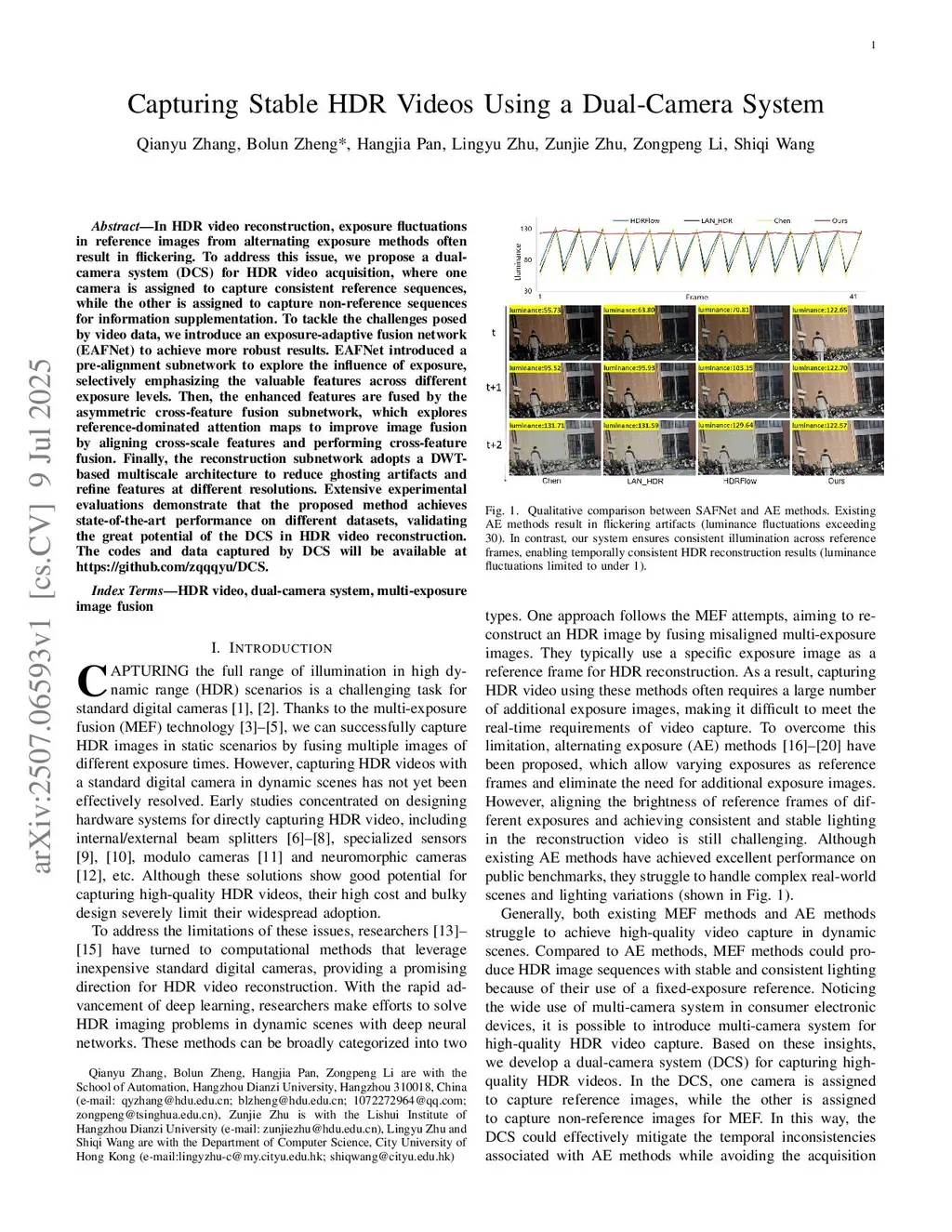
High Dynamic Range (HDR) video acquisition using the alternating exposure (AE) paradigm has garnered significant attention due to its cost-effectiveness with a single consumer camera. However, despite progress driven by deep neural networks, these methods remain prone to temporal flicker in real-world applications due to inter-frame exposure inconsistencies. To address this challenge while maintaining the cost-effectiveness of the AE paradigm, we propose a novel learning-based HDR video generation solution. Specifically, we propose a dual-stream HDR video generation paradigm that decouples temporal luminance anchoring from exposure-variant detail reconstruction, overcoming the inherent limitations of the AE paradigm. To support this, we design an asynchronous dual-camera system (DCS), which enables independent exposure control across two cameras, eliminating the need for synchronization typically required in traditional multi-camera setups. Furthermore, an exposure-adaptive fusion network (EAFNet) is formulated for the DCS system. EAFNet integrates a pre-alignment subnetwork that aligns features across varying exposures, ensuring robust feature extraction for subsequent fusion, an asymmetric cross-feature fusion subnetwork that emphasizes reference-based attention to effectively merge these features across exposures, and a reconstruction subnetwork to mitigate ghosting artifacts and preserve fine details. Extensive experimental evaluations demonstrate that the proposed method achieves state-of-the-art performance across various datasets, showing the remarkable potential of our solution in HDR video reconstruction. The codes and data captured by DCS will be available atthis https URL.
View on arXiv