
Towards Imperceptible JPEG Image Hiding: Multi-range Representations-driven Adversarial Stego Generation
- AAML
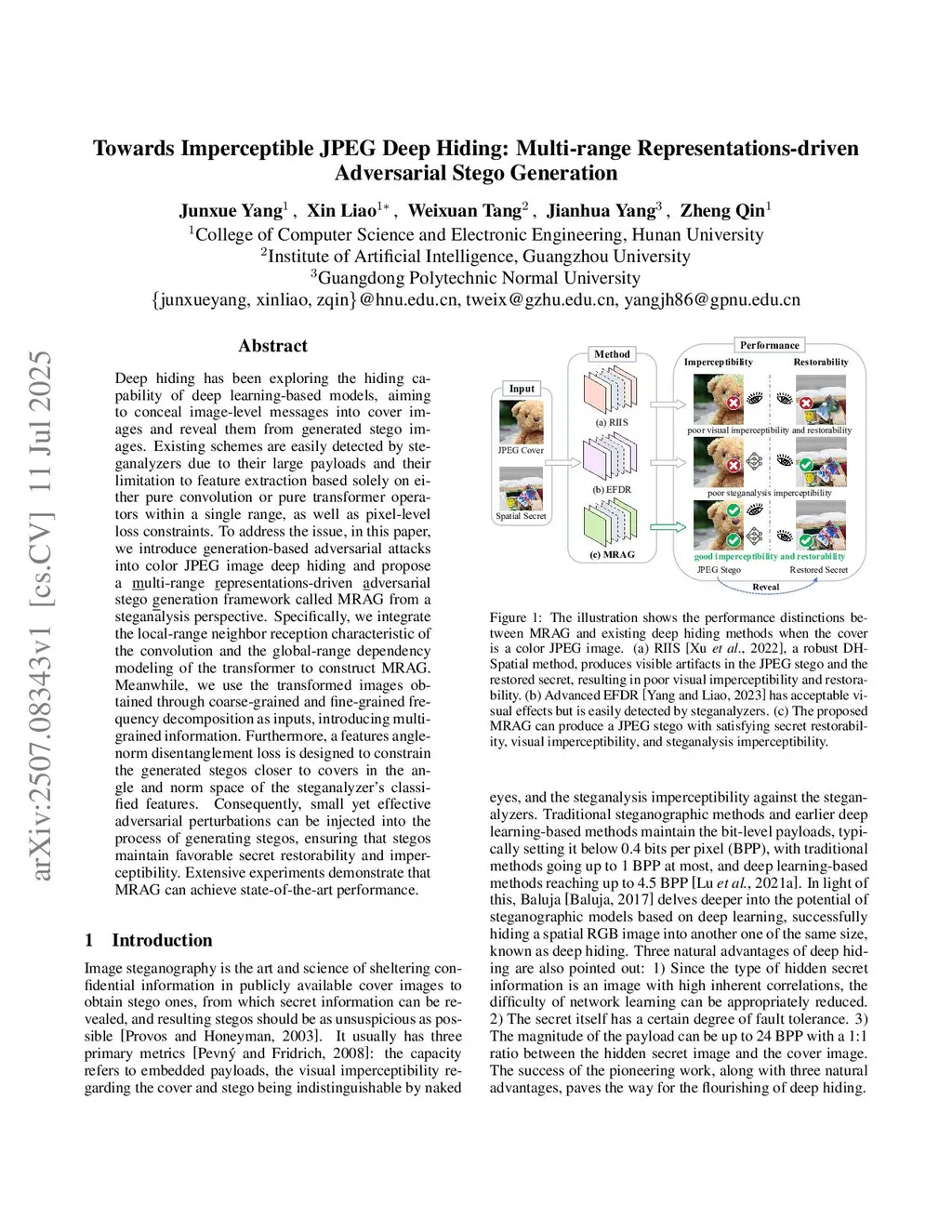
Image hiding fully explores the hidden potential of deep learning-based models, aiming to conceal image-level messages within cover images and reveal them from stego images to achieve covert communication. Existing hiding schemes are easily detected by the naked eyes or steganalyzers due to the cover type confined to the spatial domain, single-range feature extraction and attacks, and insufficient loss constraints. To address these issues, we propose a multi-range representations-driven adversarial stego generation framework called MRAG for JPEG image hiding. This design stems from the fact that steganalyzers typically combine local-range and global-range information to better capture hidden traces. Specifically, MRAG integrates the local-range characteristic of the convolution and the global-range modeling of the transformer. Meanwhile, a features angle-norm disentanglement loss is designed to launch multi-range representations-driven feature-level adversarial attacks. It computes the adversarial loss between covers and stegos based on the surrogate steganalyzer's classified features, i.e., the features before the last fully connected layer. Under the dual constraints of features angle and norm, MRAG can delicately encode the concatenation of cover and secret into subtle adversarial perturbations from local and global ranges relevant to steganalysis. Therefore, the resulting stego can achieve visual and steganalysis imperceptibility. Moreover, coarse-grained and fine-grained frequency decomposition operations are devised to transform the input, introducing multi-grained information. Extensive experiments demonstrate that MRAG can achieve state-of-the-art performance.
View on arXiv