
SeqCSIST: Sequential Closely-Spaced Infrared Small Target Unmixing
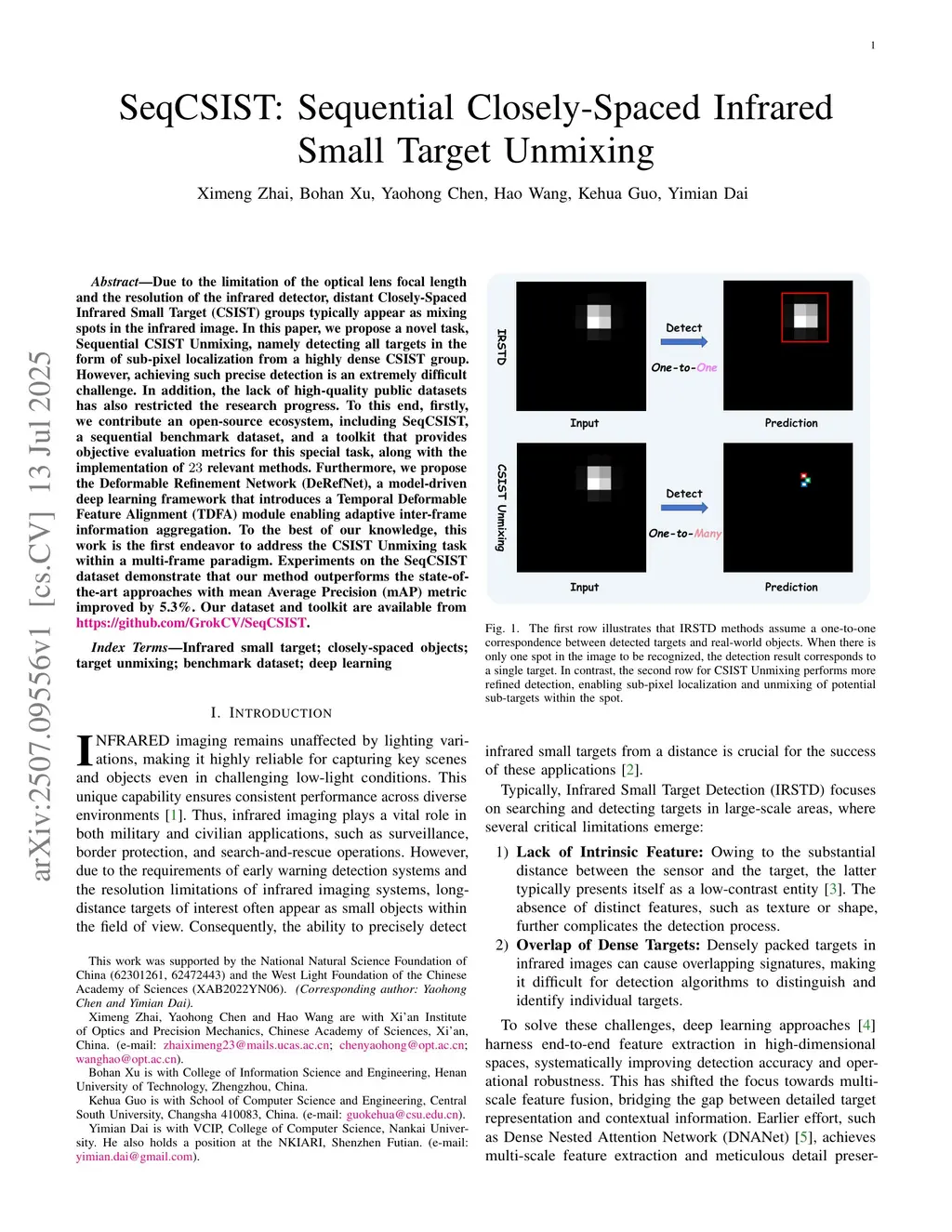
Due to the limitation of the optical lens focal length and the resolution of the infrared detector, distant Closely-Spaced Infrared Small Target (CSIST) groups typically appear as mixing spots in the infrared image. In this paper, we propose a novel task, Sequential CSIST Unmixing, namely detecting all targets in the form of sub-pixel localization from a highly dense CSIST group. However, achieving such precise detection is an extremely difficult challenge. In addition, the lack of high-quality public datasets has also restricted the research progress. To this end, firstly, we contribute an open-source ecosystem, including SeqCSIST, a sequential benchmark dataset, and a toolkit that provides objective evaluation metrics for this special task, along with the implementation of 23 relevant methods. Furthermore, we propose the Deformable Refinement Network (DeRefNet), a model-driven deep learning framework that introduces a Temporal Deformable Feature Alignment (TDFA) module enabling adaptive inter-frame information aggregation. To the best of our knowledge, this work is the first endeavor to address the CSIST Unmixing task within a multi-frame paradigm. Experiments on the SeqCSIST dataset demonstrate that our method outperforms the state-of-the-art approaches with mean Average Precision (mAP) metric improved by 5.3\%. Our dataset and toolkit are available fromthis https URL.
View on arXiv