
Digital twins for the design, interactive control, and deployment of modular, fiber-reinforced soft continuum arms
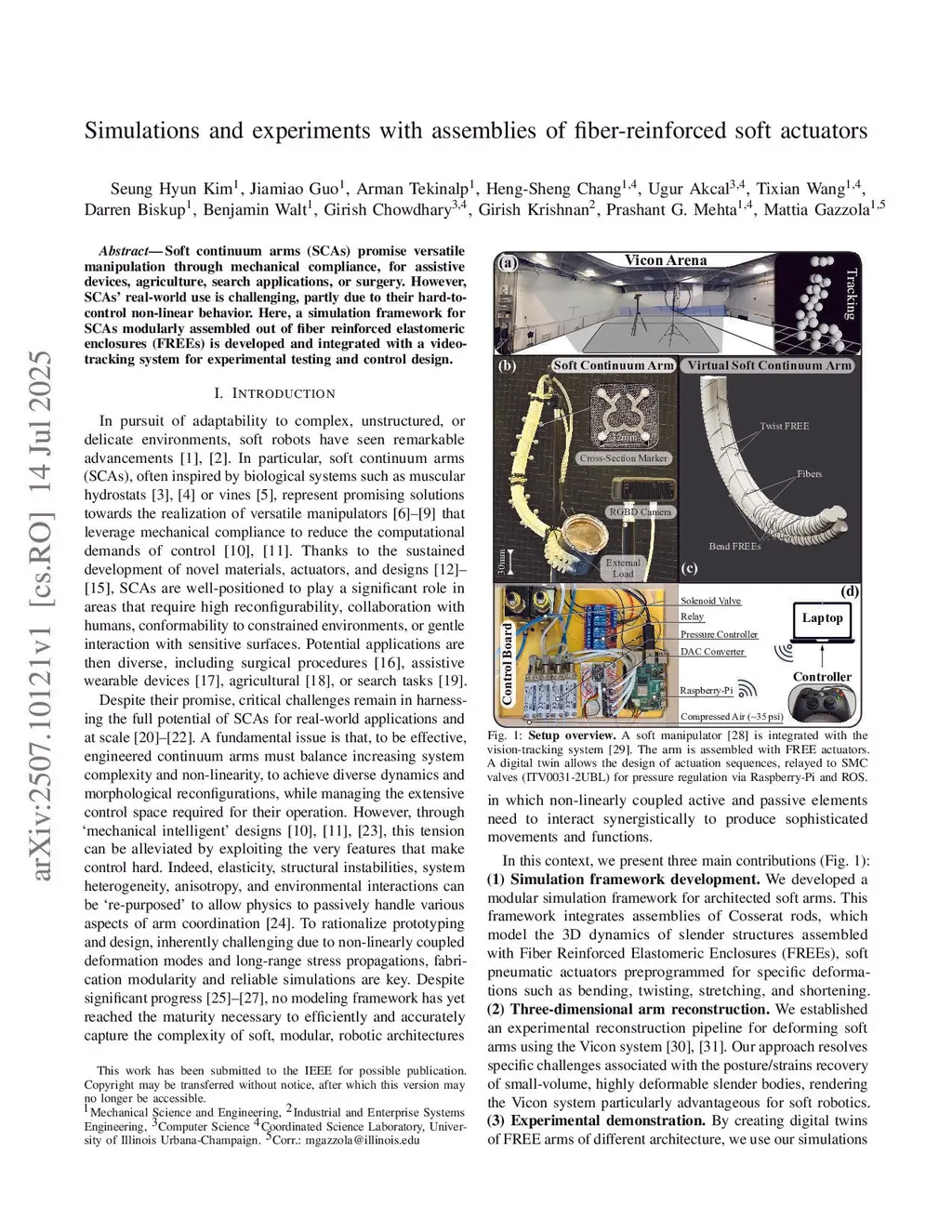
Soft continuum arms (SCAs) promise versatile manipulation through mechanical compliance, for assistive devices, agriculture, search applications, or surgery. However, the strong nonlinear coupling between materials, morphology, and actuation renders design and control challenging, hindering real-world deployment. In this context, a modular fabrication strategy paired with reliable, interactive simulations would be highly beneficial, streamlining prototyping and control design. Here, we present a digital twin framework for modular SCAs realized using pneumatic Fiber-Reinforced Elastomeric Enclosures (FREEs). The approach models assemblies of FREE actuators through networks of Cosserat rods, favoring the accurate simulation of three-dimensional arm reconfigurations, while explicitly preserving internal modular architecture. This enables the quantitative analysis and scalable development of composite soft robot arms, overcoming limitations of current monolithic continuum models. To validate the framework, we introduce a three-dimensional reconstruction pipeline tailored to soft, slender, small-volume, and highly deformable structures, allowing reliable recovery of arm kinematics and strain distributions. Experimental results across multiple configurations and actuation regimes demonstrate close agreement with simulations. Finally, we embed the digital twins in a virtual environment to allow interactive control design and sim-to-real deployment, establishing a foundation for principled co-design and remote operation of modular soft continuum manipulators.
View on arXiv