
Mixed Discrete and Continuous Planning using Shortest Walks in Graphs of Convex Sets
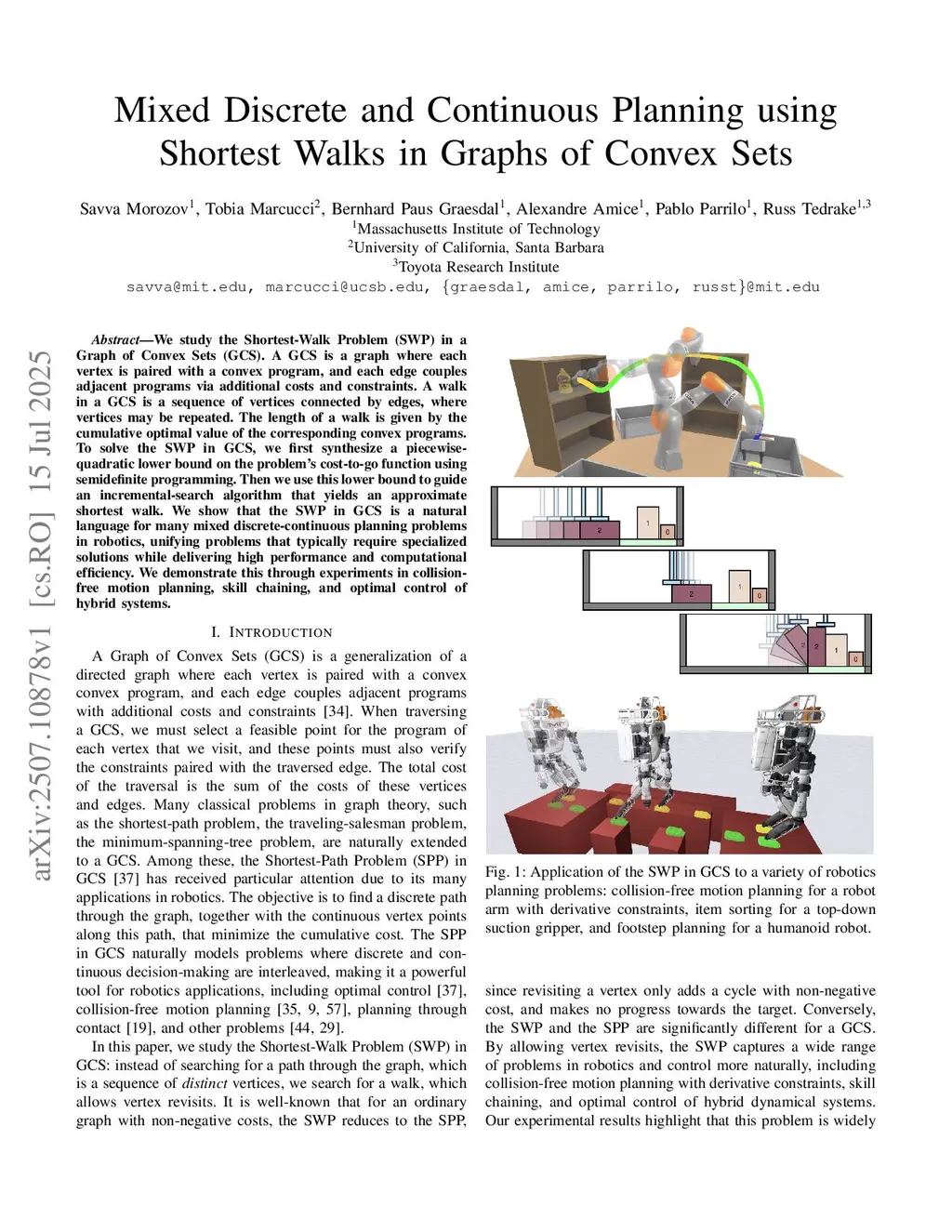
We study the Shortest-Walk Problem (SWP) in a Graph of Convex Sets (GCS). A GCS is a graph where each vertex is paired with a convex program, and each edge couples adjacent programs via additional costs and constraints. A walk in a GCS is a sequence of vertices connected by edges, where vertices may be repeated. The length of a walk is given by the cumulative optimal value of the corresponding convex programs. To solve the SWP in GCS, we first synthesize a piecewise-quadratic lower bound on the problem's cost-to-go function using semidefinite programming. Then we use this lower bound to guide an incremental-search algorithm that yields an approximate shortest walk. We show that the SWP in GCS is a natural language for many mixed discrete-continuous planning problems in robotics, unifying problems that typically require specialized solutions while delivering high performance and computational efficiency. We demonstrate this through experiments in collision-free motion planning, skill chaining, and optimal control of hybrid systems.
View on arXiv