
Journalism-Guided Agentic In-Context Learning for News Stance Detection
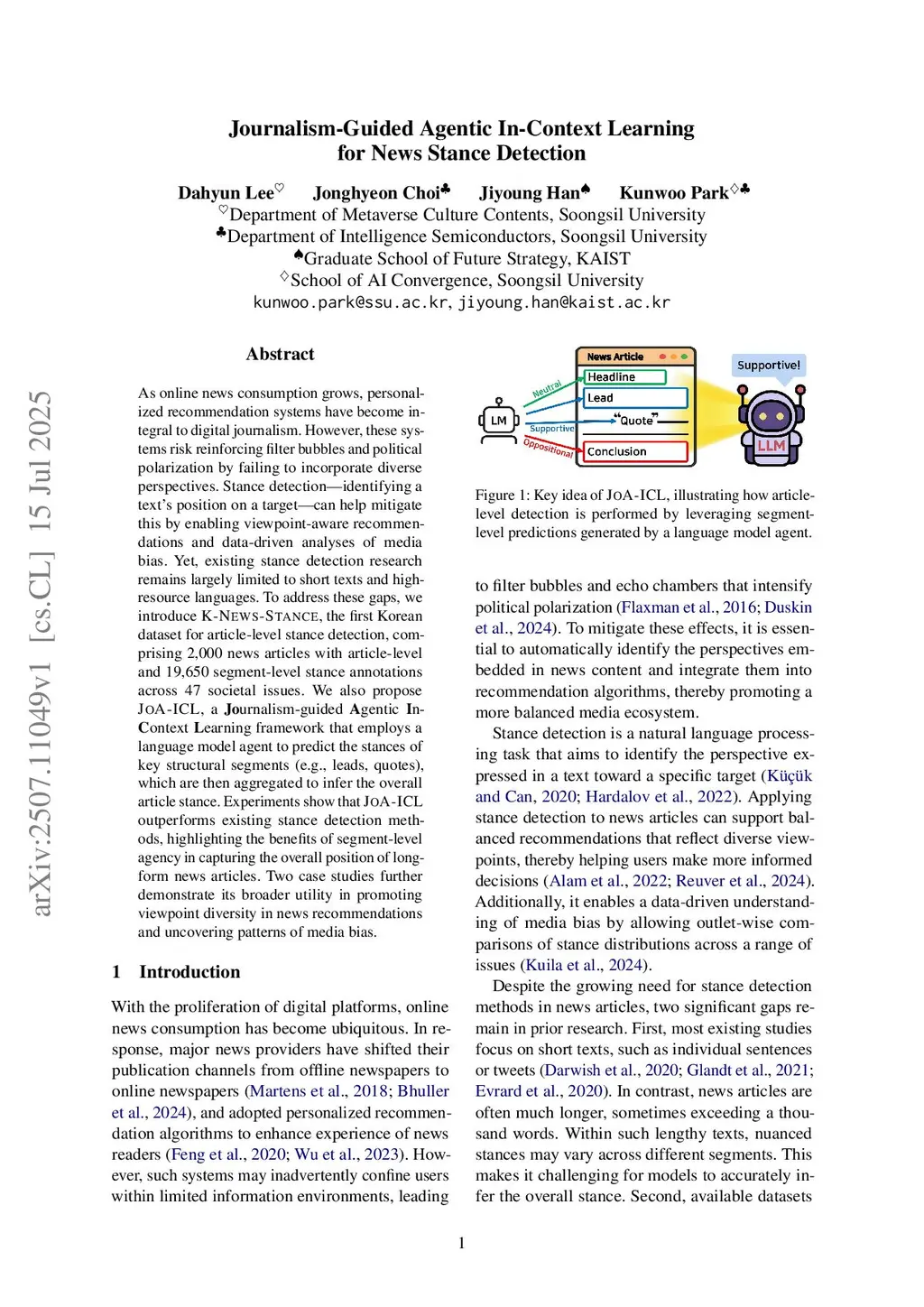
As online news consumption grows, personalized recommendation systems have become integral to digital journalism. However, these systems risk reinforcing filter bubbles and political polarization by failing to incorporate diverse perspectives. Stance detection -- identifying a text's position on a target -- can help mitigate this by enabling viewpoint-aware recommendations and data-driven analyses of media bias. Yet, existing stance detection research remains largely limited to short texts and high-resource languages. To address these gaps, we introduce \textsc{K-News-Stance}, the first Korean dataset for article-level stance detection, comprising 2,000 news articles with article-level and 21,650 segment-level stance annotations across 47 societal issues. We also propose \textsc{JoA-ICL}, a \textbf{Jo}urnalism-guided \textbf{A}gentic \textbf{I}n-\textbf{C}ontext \textbf{L}earning framework that employs a language model agent to predict the stances of key structural segments (e.g., leads, quotations), which are then aggregated to infer the overall article stance. Experiments showed that \textsc{JoA-ICL} outperforms existing stance detection methods, highlighting the benefits of segment-level agency in capturing the overall position of long-form news articles. Two case studies further demonstrate its broader utility in promoting viewpoint diversity in news recommendations and uncovering patterns of media bias.
View on arXiv