
Mitigating Object Hallucinations via Sentence-Level Early Intervention
- MLLM
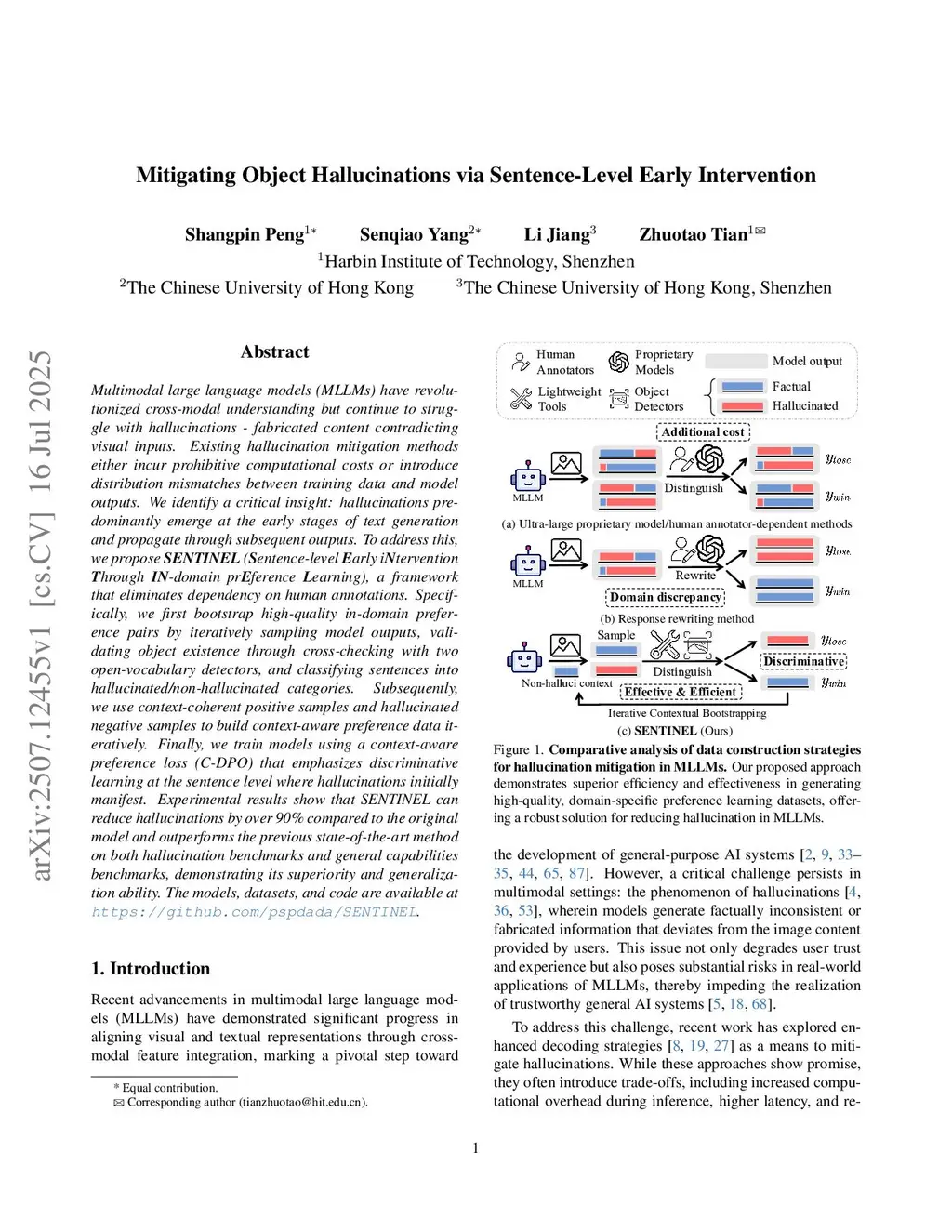
Multimodal large language models (MLLMs) have revolutionized cross-modal understanding but continue to struggle with hallucinations - fabricated content contradicting visual inputs. Existing hallucination mitigation methods either incur prohibitive computational costs or introduce distribution mismatches between training data and model outputs. We identify a critical insight: hallucinations predominantly emerge at the early stages of text generation and propagate through subsequent outputs. To address this, we propose **SENTINEL** (**S**entence-level **E**arly i**N**tervention **T**hrough **IN**-domain pr**E**ference **L**earning), a framework that eliminates dependency on human annotations. Specifically, we first bootstrap high-quality in-domain preference pairs by iteratively sampling model outputs, validating object existence through cross-checking with two open-vocabulary detectors, and classifying sentences into hallucinated/non-hallucinated categories. Subsequently, we use context-coherent positive samples and hallucinated negative samples to build context-aware preference data iteratively. Finally, we train models using a context-aware preference loss (C-DPO) that emphasizes discriminative learning at the sentence level where hallucinations initially manifest. Experimental results show that SENTINEL can reduce hallucinations by over 90\% compared to the original model and outperforms the previous state-of-the-art method on both hallucination benchmarks and general capabilities benchmarks, demonstrating its superiority and generalization ability. The models, datasets, and code are available at this https URL.
View on arXiv