
The Query Complexity of Uniform Pricing
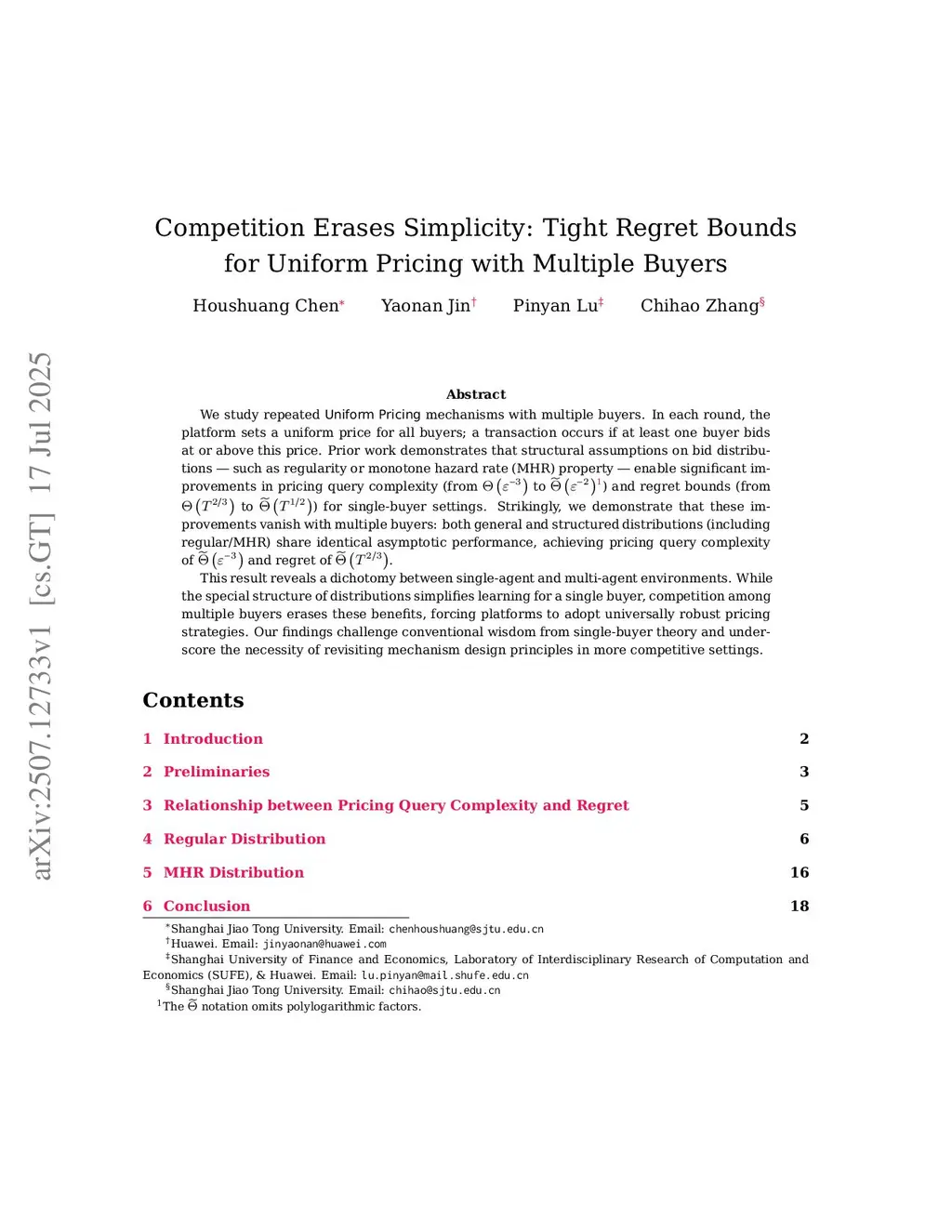
Real-world pricing mechanisms are typically optimized using training data, a setting corresponding to the \textit{pricing query complexity} problem in Mechanism Design. The previous work [LSTW23] studies the \textit{single-distribution} case, with tight bounds of for a \textit{general} distribution and for either a \textit{regular} or \textit{monotone-hazard-rate (MHR)} distribution, where denotes the (additive) revenue loss of a learned uniform price relative to the Bayesian-optimal uniform price.This can be directly interpreted as ``the query complexity of the {\em \textsf{Uniform Pricing}} mechanism, in the \textit{single-distribution} case''. Yet in the \textit{multi-distribution} case, can the regularity and MHR conditions still lead to improvements over the tight bound for general distributions? We answer this question in the negative, by establishing a (near-)matching lower bound for either \textit{two regular distributions} or \textit{three MHR distributions}.We also address the \textit{regret minimization} problem and, in comparison with the folklore upper bound for general distributions (see, e.g., [SW24]), establish a (near-)matching lower bound for either \textit{two regular distributions} or \textit{three MHR distributions}, via a black-box reduction. Again, this is in stark contrast to the tight bound for a single regular or MHR distribution.
View on arXiv