
Trustworthy Pedestrian Trajectory Prediction via Pattern-Aware Interaction Modeling
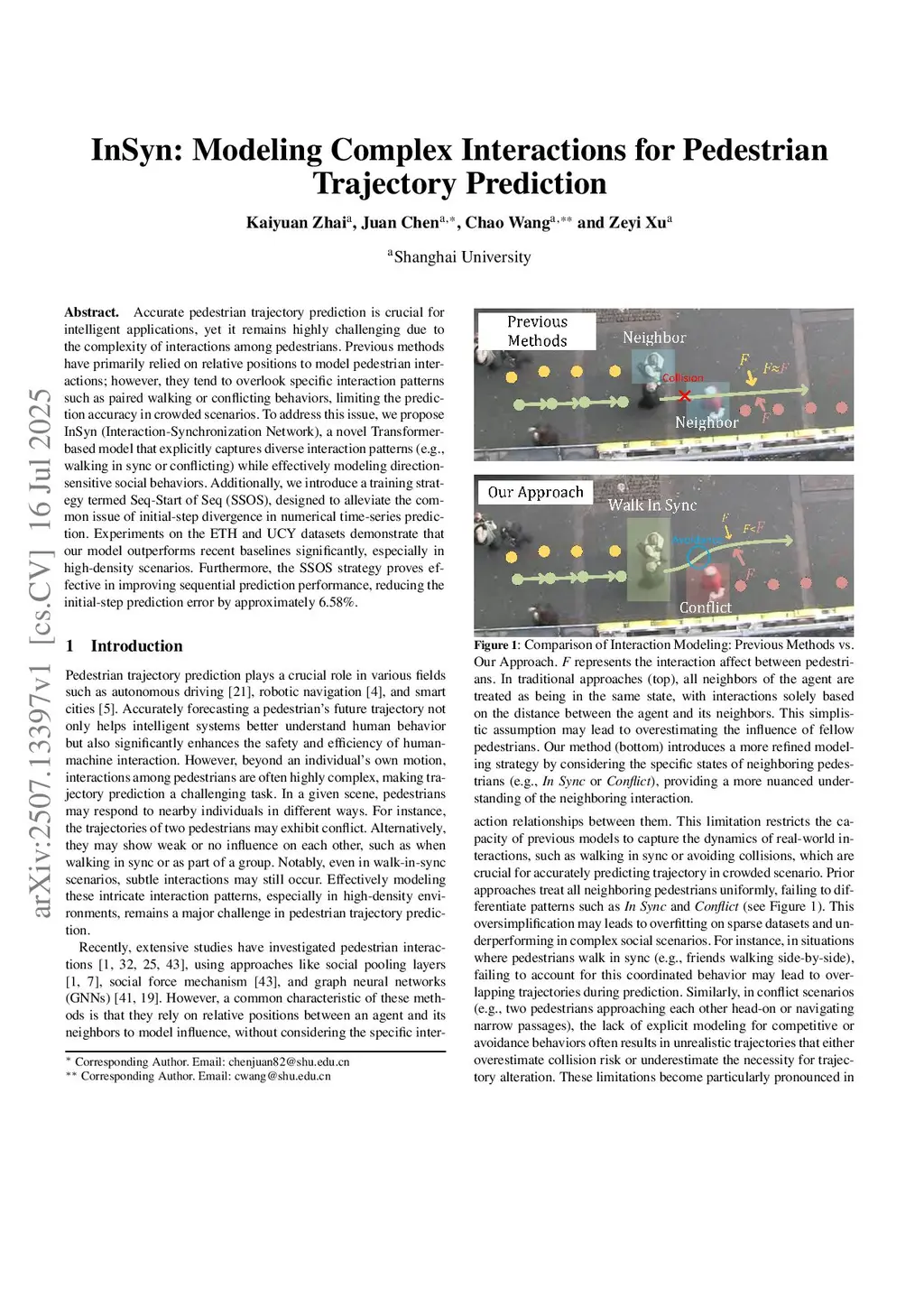
Accurate and reliable pedestrian trajectory prediction is critical for the safety and robustness of intelligent applications, yet achieving trustworthy prediction remains highly challenging due to the complexity of interactions among pedestrians. Previous methods often adopt black-box modeling of pedestrian interactions, treating all neighbors uniformly. Despite their strong performance, such opaque modeling limits the reliability of predictions in safety-critical real-world deployments. To address this issue, we propose InSyn (Interaction-Synchronization Network), a novel Transformer-based model that explicitly captures diverse interaction patterns (e.g., walking in sync or conflicting) while effectively modeling direction-sensitive social behaviors. Additionally, we introduce a training strategy, termed Seq-Start of Seq (SSOS), designed to alleviate the common issue of initial-step divergence in numerical time-series prediction. Experiments on the ETH and UCY datasets demonstrate that our model not only outperforms recent black-box baselines in prediction accuracy, especially under high-density scenarios, but also provides stronger interpretability, achieving a favorable trade-off between reliability and accuracy. Furthermore, the SSOS strategy proves to be effective in improving sequential prediction performance, reducing the initial-step prediction error by approximately 6.58%.
View on arXiv