
Koopman Operator Based Linear Model Predictive Control for 2D Quadruped Trotting, Bounding, and Gait Transition
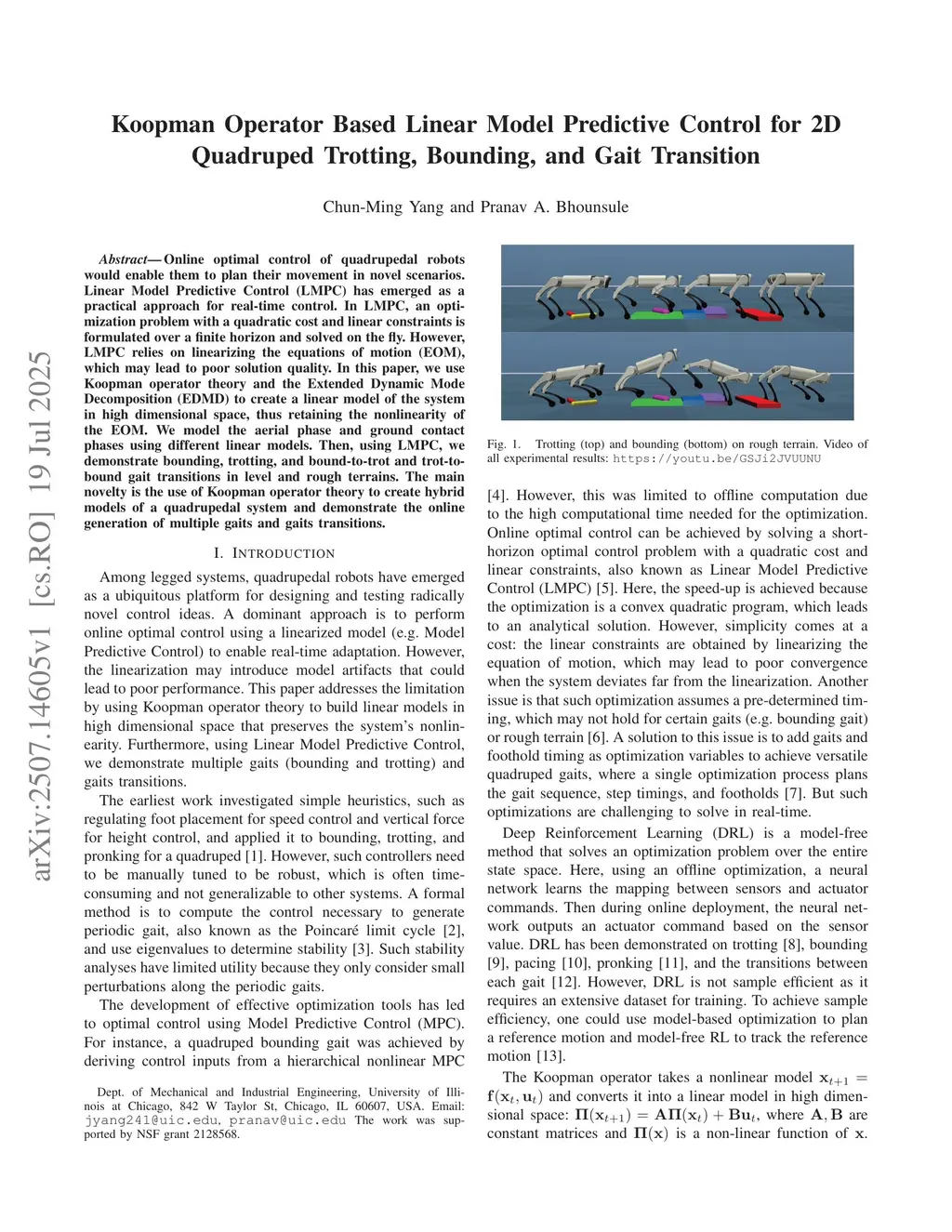
Online optimal control of quadrupedal robots would enable them to plan their movement in novel scenarios. Linear Model Predictive Control (LMPC) has emerged as a practical approach for real-time control. In LMPC, an optimization problem with a quadratic cost and linear constraints is formulated over a finite horizon and solved on the fly. However, LMPC relies on linearizing the equations of motion (EOM), which may lead to poor solution quality. In this paper, we use Koopman operator theory and the Extended Dynamic Mode Decomposition (EDMD) to create a linear model of the system in high dimensional space, thus retaining the nonlinearity of the EOM. We model the aerial phase and ground contact phases using different linear models. Then, using LMPC, we demonstrate bounding, trotting, and bound-to-trot and trot-to-bound gait transitions in level and rough terrains. The main novelty is the use of Koopman operator theory to create hybrid models of a quadrupedal system and demonstrate the online generation of multiple gaits and gaits transitions.
View on arXiv