
GUI-G: Gaussian Reward Modeling for GUI Grounding
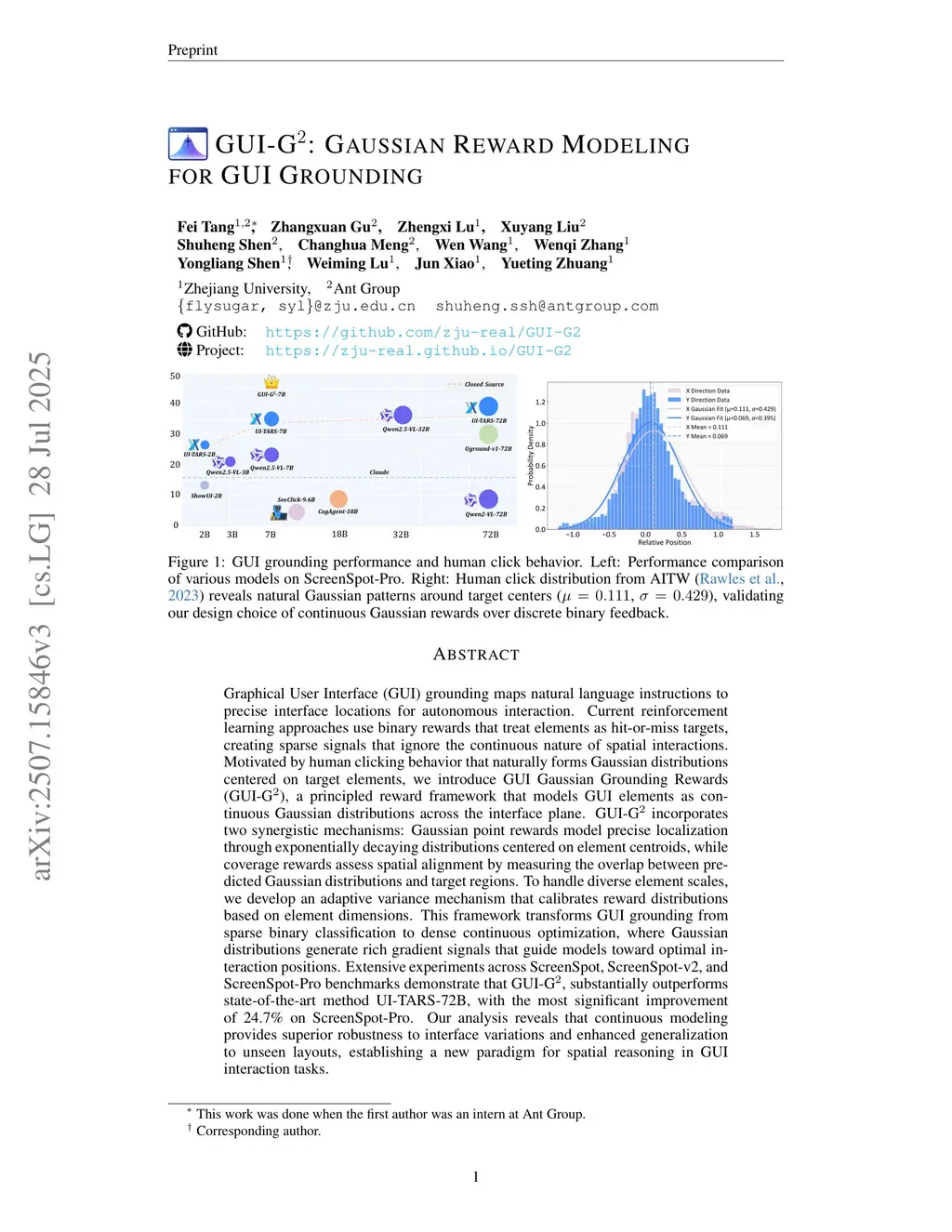
Graphical User Interface (GUI) grounding maps natural language instructions to precise interface locations for autonomous interaction. Current reinforcement learning approaches use binary rewards that treat elements as hit-or-miss targets, creating sparse signals that ignore the continuous nature of spatial interactions. Motivated by human clicking behavior that naturally forms Gaussian distributions centered on target elements, we introduce GUI Gaussian Grounding Rewards (GUI-G), a principled reward framework that models GUI elements as continuous Gaussian distributions across the interface plane. GUI-G incorporates two synergistic mechanisms: Gaussian point rewards model precise localization through exponentially decaying distributions centered on element centroids, while coverage rewards assess spatial alignment by measuring the overlap between predicted Gaussian distributions and target regions. To handle diverse element scales, we develop an adaptive variance mechanism that calibrates reward distributions based on element dimensions. This framework transforms GUI grounding from sparse binary classification to dense continuous optimization, where Gaussian distributions generate rich gradient signals that guide models toward optimal interaction positions. Extensive experiments across ScreenSpot, ScreenSpot-v2, and ScreenSpot-Pro benchmarks demonstrate that GUI-G, substantially outperforms state-of-the-art method UI-TARS-72B, with the most significant improvement of 24.7% on ScreenSpot-Pro. Our analysis reveals that continuous modeling provides superior robustness to interface variations and enhanced generalization to unseen layouts, establishing a new paradigm for spatial reasoning in GUI interaction tasks.
View on arXiv