
Structural DID with ML: Theory, Simulation, and a Roadmap for Applied Research
- CML
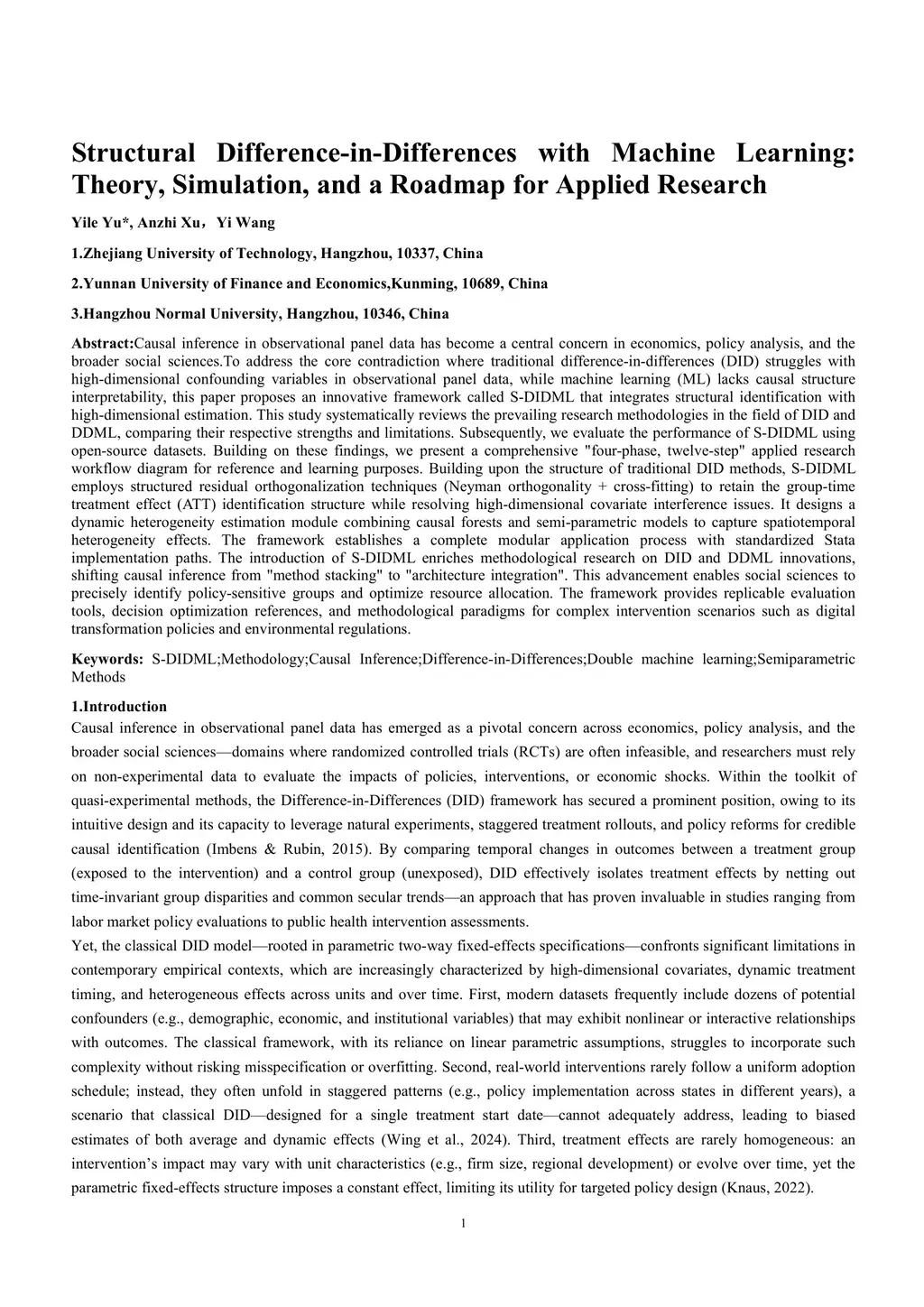
Causal inference in observational panel data has become a central concern in economics,policy analysis,and the broader socialthis http URLaddress the core contradiction where traditional difference-in-differences (DID) struggles with high-dimensional confounding variables in observational panel data,while machine learning (ML) lacks causal structure interpretability,this paper proposes an innovative framework called S-DIDML that integrates structural identification with high-dimensionalthis http URLupon the structure of traditional DID methods,S-DIDML employs structured residual orthogonalization techniques (Neyman orthogonality+cross-fitting) to retain the group-time treatment effect (ATT) identification structure while resolving high-dimensional covariate interferencethis http URLdesigns a dynamic heterogeneity estimation module combining causal forests and semi-parametric models to capture spatiotemporal heterogeneitythis http URLframework establishes a complete modular application process with standardized Stata implementationthis http URLintroduction of S-DIDML enriches methodological research on DID and DDML innovations, shifting causal inference from method stacking to architecturethis http URLadvancement enables social sciences to precisely identify policy-sensitive groups and optimize resourcethis http URLframework provides replicable evaluation tools, decision optimization references,and methodological paradigms for complex intervention scenarios such as digital transformation policies and environmental regulations.
View on arXiv