
Enhancing Fatigue Detection through Heterogeneous Multi-Source Data Integration and Cross-Domain Modality Imputation
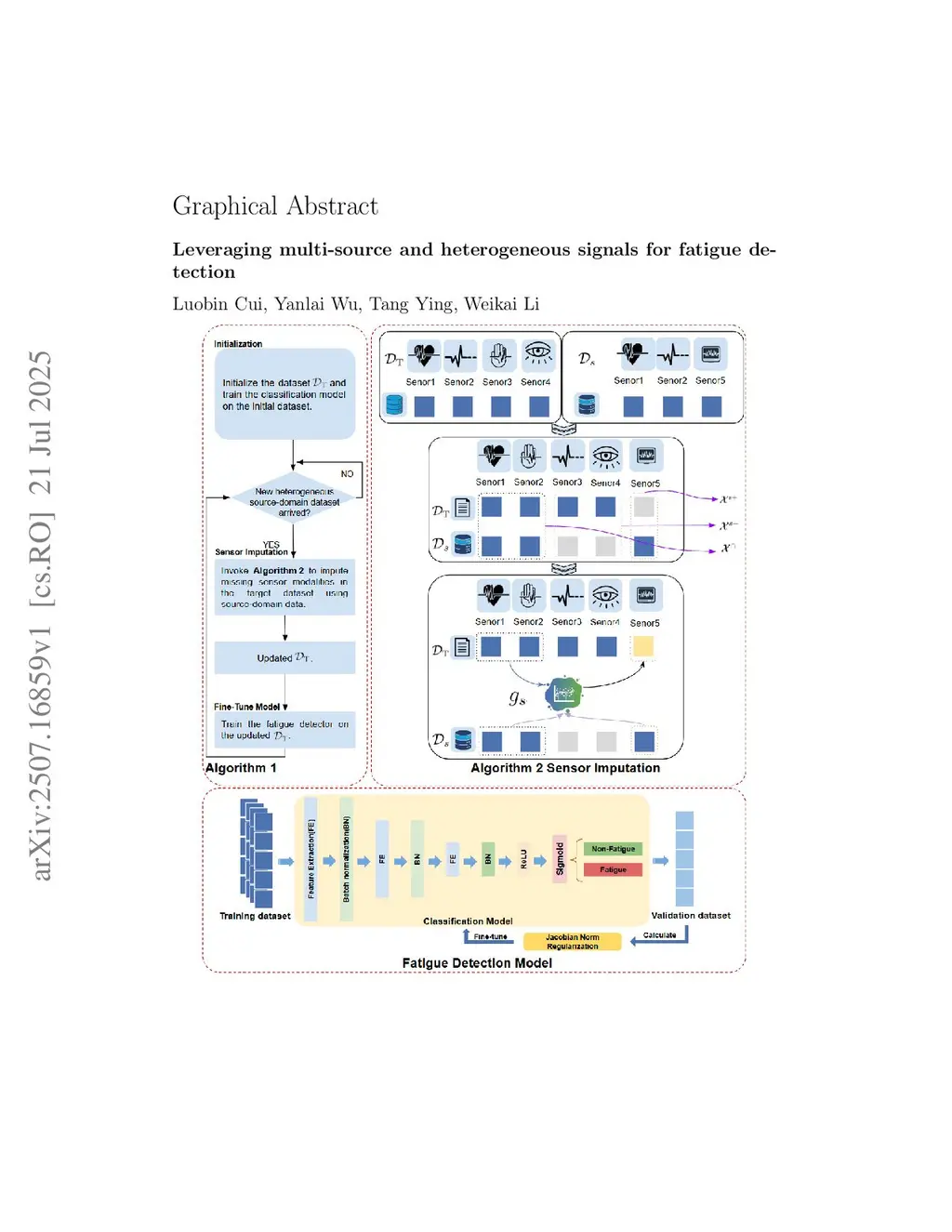
Fatigue detection for human operators plays a key role in safety critical applications such as aviation, mining, and long haul transport. While numerous studies have demonstrated the effectiveness of high fidelity sensors in controlled laboratory environments, their performance often degrades when ported to real world settings due to noise, lighting conditions, and field of view constraints, thereby limiting their practicality. This paper formalizes a deployment oriented setting for real world fatigue detection, where high quality sensors are often unavailable in practical applications. To address this challenge, we propose leveraging knowledge from heterogeneous source domains, including high fidelity sensors that are difficult to deploy in the field but commonly used in controlled environments, to assist fatigue detection in the real world target domain. Building on this idea, we design a heterogeneous and multiple source fatigue detection framework that adaptively utilizes the available modalities in the target domain while exploiting diverse configurations in the source domains through alignment across domains and modality imputation. Our experiments, conducted using a field deployed sensor setup and two publicly available human fatigue datasets, demonstrate the practicality, robustness, and improved generalization of our approach across subjects and domains. The proposed method achieves consistent gains over strong baselines in sensor constrained scenarios. This work has been submitted to the IEEE for possible publication. Copyright may be transferred without notice, after which this version may no longer be accessible.
View on arXiv