
Asymmetric Lesion Detection with Geometric Patterns and CNN-SVM Classification
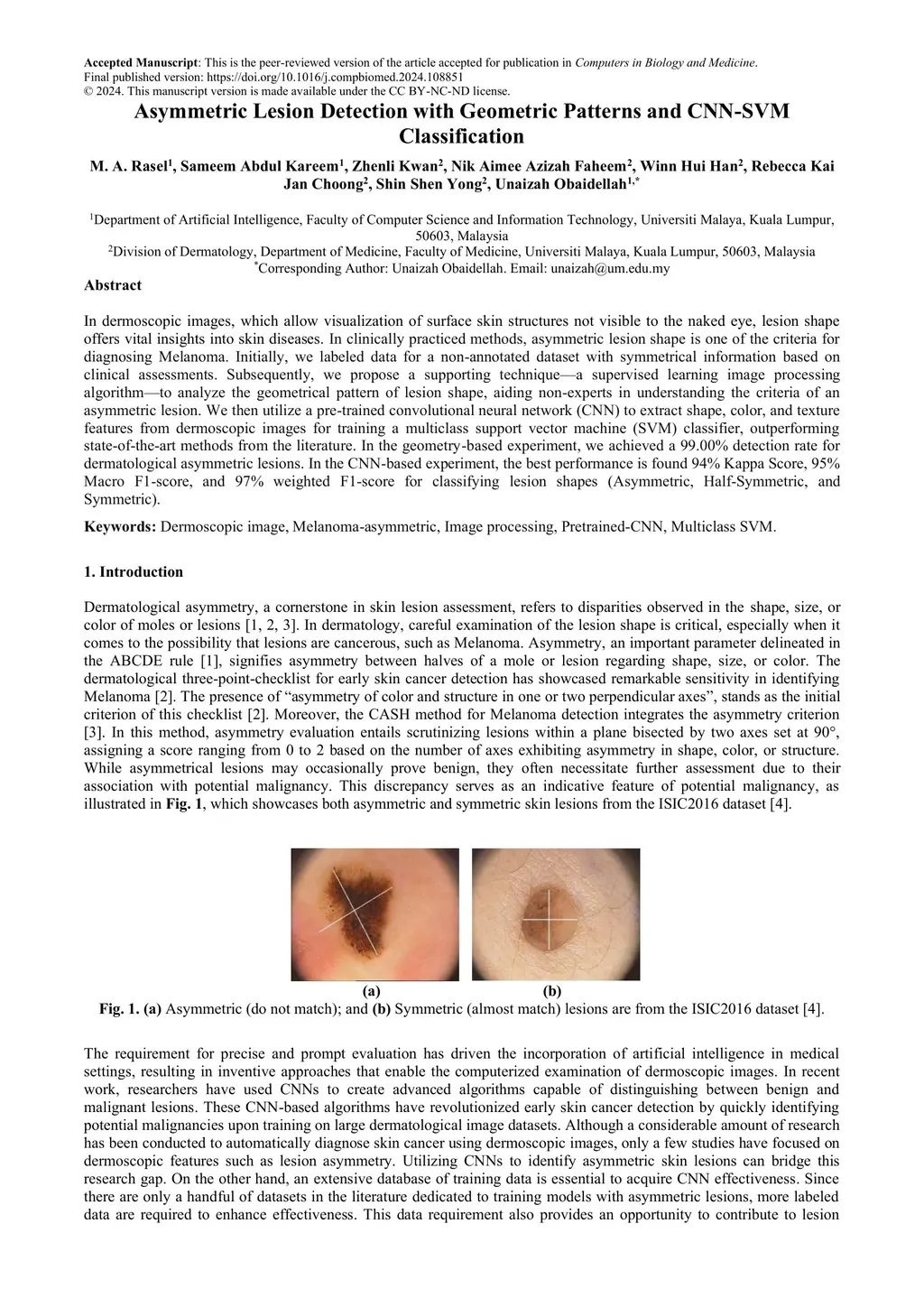
In dermoscopic images, which allow visualization of surface skin structures not visible to the naked eye, lesion shape offers vital insights into skin diseases. In clinically practiced methods, asymmetric lesion shape is one of the criteria for diagnosing melanoma. Initially, we labeled data for a non-annotated dataset with symmetrical information based on clinical assessments. Subsequently, we propose a supporting technique, a supervised learning image processing algorithm, to analyze the geometrical pattern of lesion shape, aiding non-experts in understanding the criteria of an asymmetric lesion. We then utilize a pre-trained convolutional neural network (CNN) to extract shape, color, and texture features from dermoscopic images for training a multiclass support vector machine (SVM) classifier, outperforming state-of-the-art methods from the literature. In the geometry-based experiment, we achieved a 99.00% detection rate for dermatological asymmetric lesions. In the CNN-based experiment, the best performance is found with 94% Kappa Score, 95% Macro F1-score, and 97% Weighted F1-score for classifying lesion shapes (Asymmetric, Half-Symmetric, and Symmetric).
View on arXiv