
HypoChainer: A Collaborative System Combining LLMs and Knowledge Graphs for Hypothesis-Driven Scientific Discovery
- AI4CE
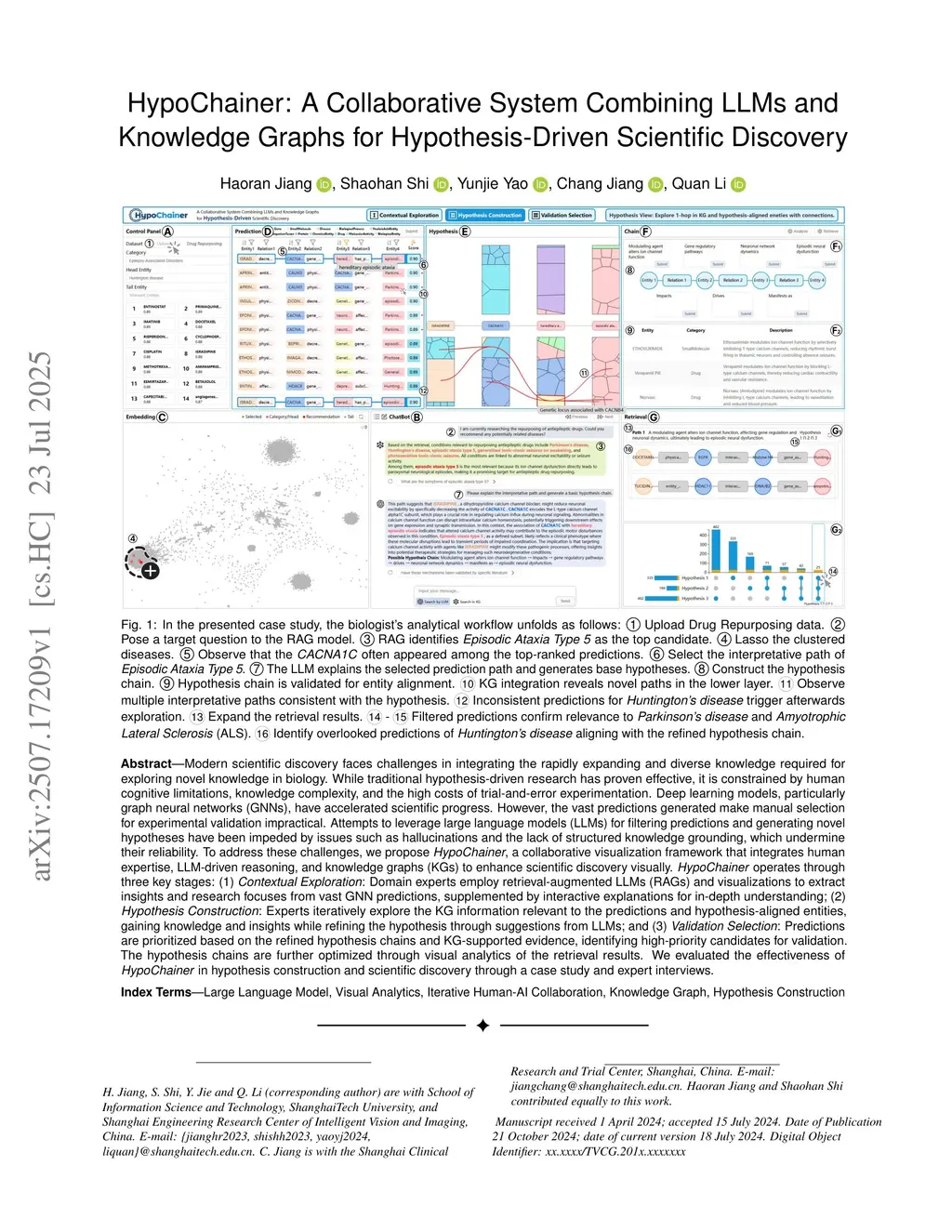
Modern scientific discovery faces growing challenges in integrating vast and heterogeneous knowledge critical to breakthroughs in biomedicine and drug development. Traditional hypothesis-driven research, though effective, is constrained by human cognitive limits, the complexity of biological systems, and the high cost of trial-and-error experimentation. Deep learning models, especially graph neural networks (GNNs), have accelerated prediction generation, but the sheer volume of outputs makes manual selection for validation unscalable. Large language models (LLMs) offer promise in filtering and hypothesis generation, yet suffer from hallucinations and lack grounding in structured knowledge, limiting their reliability. To address these issues, we propose HypoChainer, a collaborative visualization framework that integrates human expertise, LLM-driven reasoning, and knowledge graphs (KGs) to enhance hypothesis generation and validation. HypoChainer operates in three stages: First, exploration and contextualization -- experts use retrieval-augmented LLMs (RAGs) and dimensionality reduction to navigate large-scale GNN predictions, assisted by interactive explanations. Second, hypothesis chain formation -- experts iteratively examine KG relationships around predictions and semantically linked entities, refining hypotheses with LLM and KG suggestions. Third, validation prioritization -- refined hypotheses are filtered based on KG-supported evidence to identify high-priority candidates for experimentation, with visual analytics further strengthening weak links in reasoning. We demonstrate HypoChainer's effectiveness through case studies in two domains and expert interviews, highlighting its potential to support interpretable, scalable, and knowledge-grounded scientific discovery.
View on arXiv