
Flow Matching Meets Biology and Life Science: A Survey
- MedImAI4CE
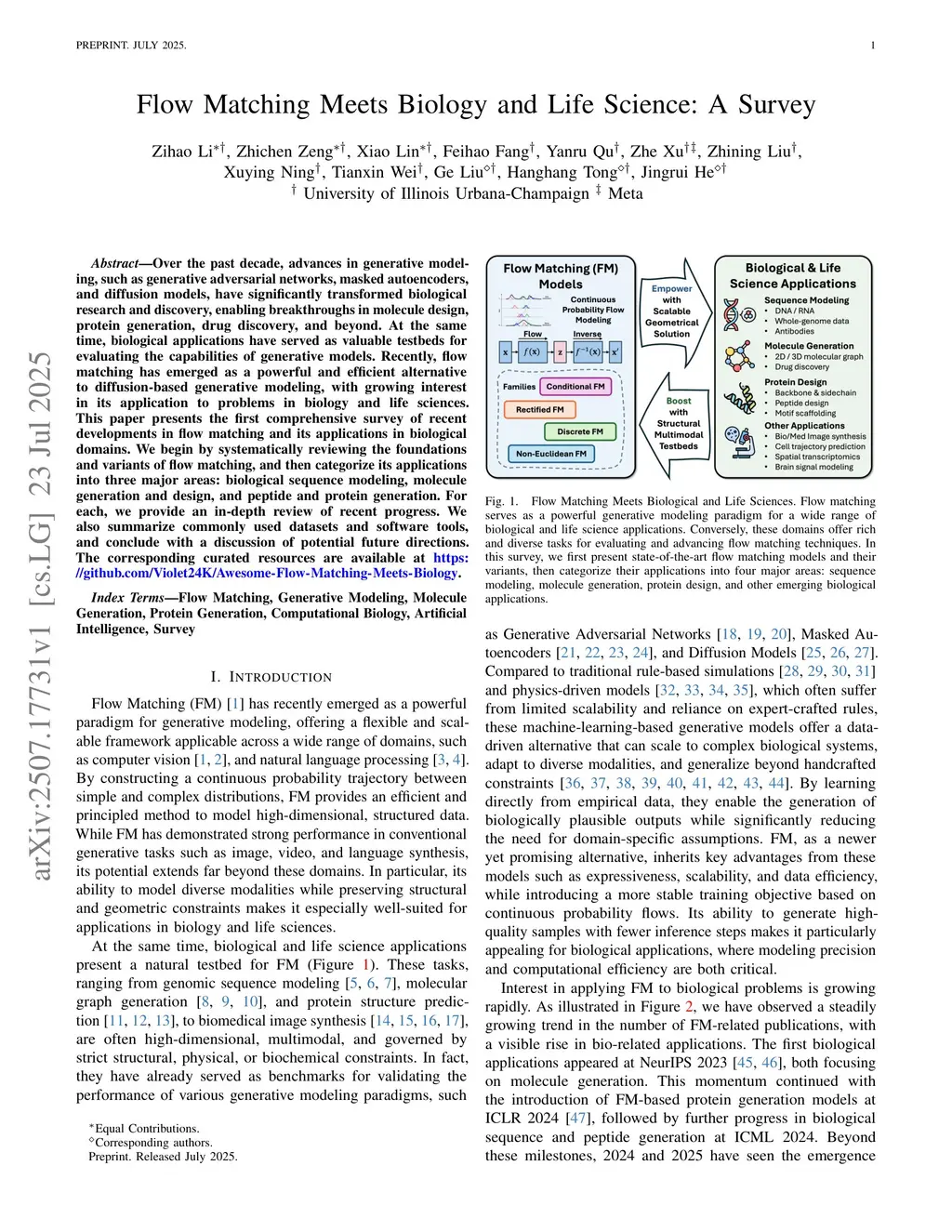
Over the past decade, advances in generative modeling, such as generative adversarial networks, masked autoencoders, and diffusion models, have significantly transformed biological research and discovery, enabling breakthroughs in molecule design, protein generation, catalysis discovery, drug discovery, and beyond. At the same time, biological applications have served as valuable testbeds for evaluating the capabilities of generative models. Recently, flow matching has emerged as a powerful and efficient alternative to diffusion-based generative modeling, with growing interest in its application to problems in biology and life sciences. This paper presents the first comprehensive survey of recent developments in flow matching and its applications in biological domains. We begin by systematically reviewing the foundations and variants of flow matching, and then categorize its applications into three major areas: biological sequence modeling, molecule generation and design, and peptide and protein generation. For each, we provide an in-depth review of recent progress. We also summarize commonly used datasets and software tools, and conclude with a discussion of potential future directions. The corresponding curated resources are available atthis https URL.
View on arXiv