
VERIRAG: A Post-Retrieval Auditing of Scientific Study Summaries
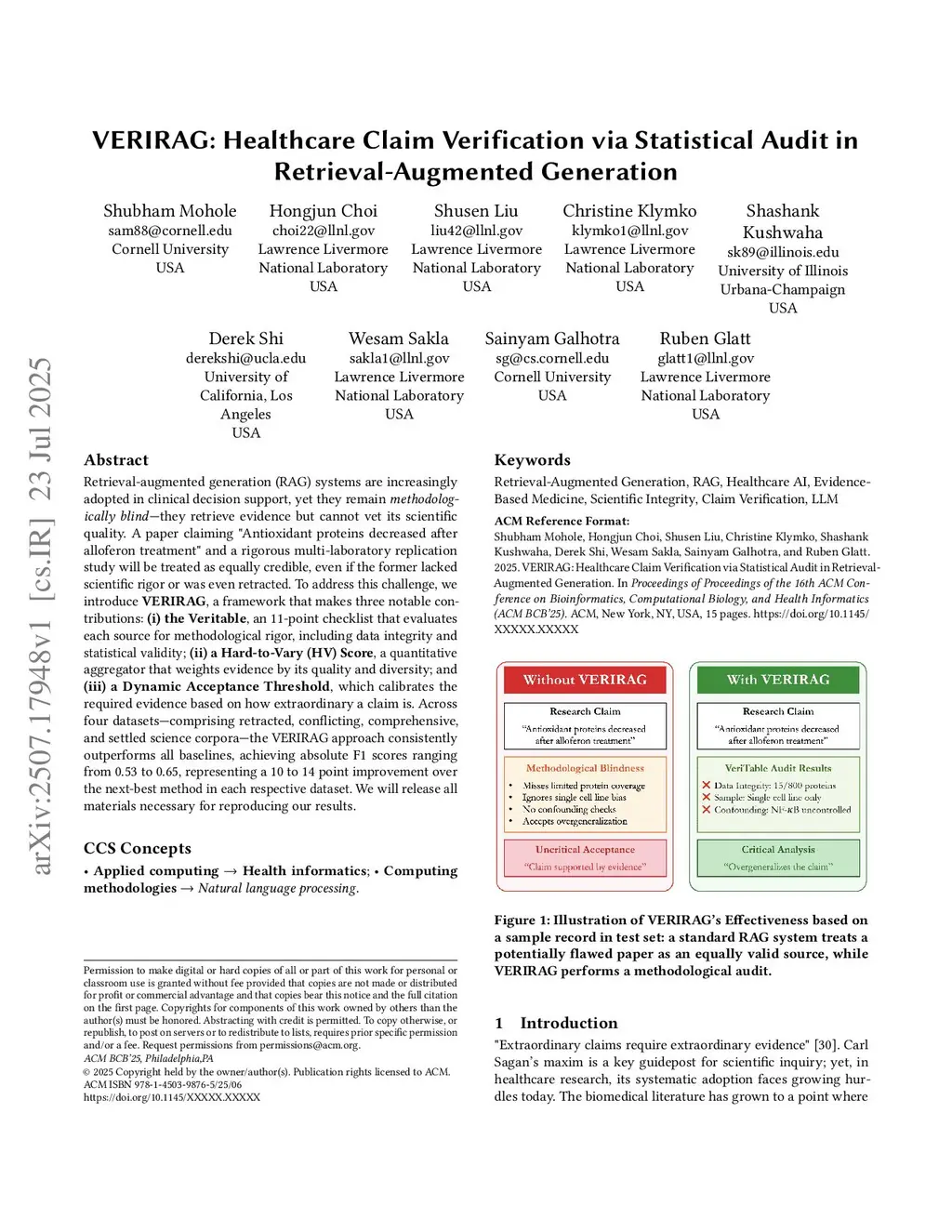
Can democratized information gatekeepers and community note writers effectively decide what scientific information to amplify? Lacking domain expertise, such gatekeepers rely on automated reasoning agents that use RAG to ground evidence to cited sources. But such standard RAG systems validate summaries via semantic grounding and suffer from "methodological blindness," treating all cited evidence as equally valid regardless of rigor. To address this, we introduce VERIRAG, a post-retrieval auditing framework that shifts the task from classification to methodological vulnerability detection. Using private Small Language Models (SLMs), VERIRAG audits source papers against the Veritable taxonomy of statistical rigor. We contribute: (1) a benchmark of 1,730 summaries with realistic, non-obvious perturbations modeled after retracted papers; (2) the auditable Veritable taxonomy; and (3) an operational system that improves Macro F1 by at least 19 points over baselines using GPT-based SLMs, a result that replicates across MISTRAL and Gemma architectures. Given the complexity of detecting non-obvious flaws, we view VERIRAG as a "vulnerability-detection copilot," providing structured audit trails for human editors. In our experiments, individual human testers found over 80% of the generated audit trails useful for decision-making. We plan to release the dataset and code to support responsible science advocacy.
View on arXiv