
PatchTraj: Unified Time-Frequency Representation Learning via Dynamic Patches for Trajectory Prediction
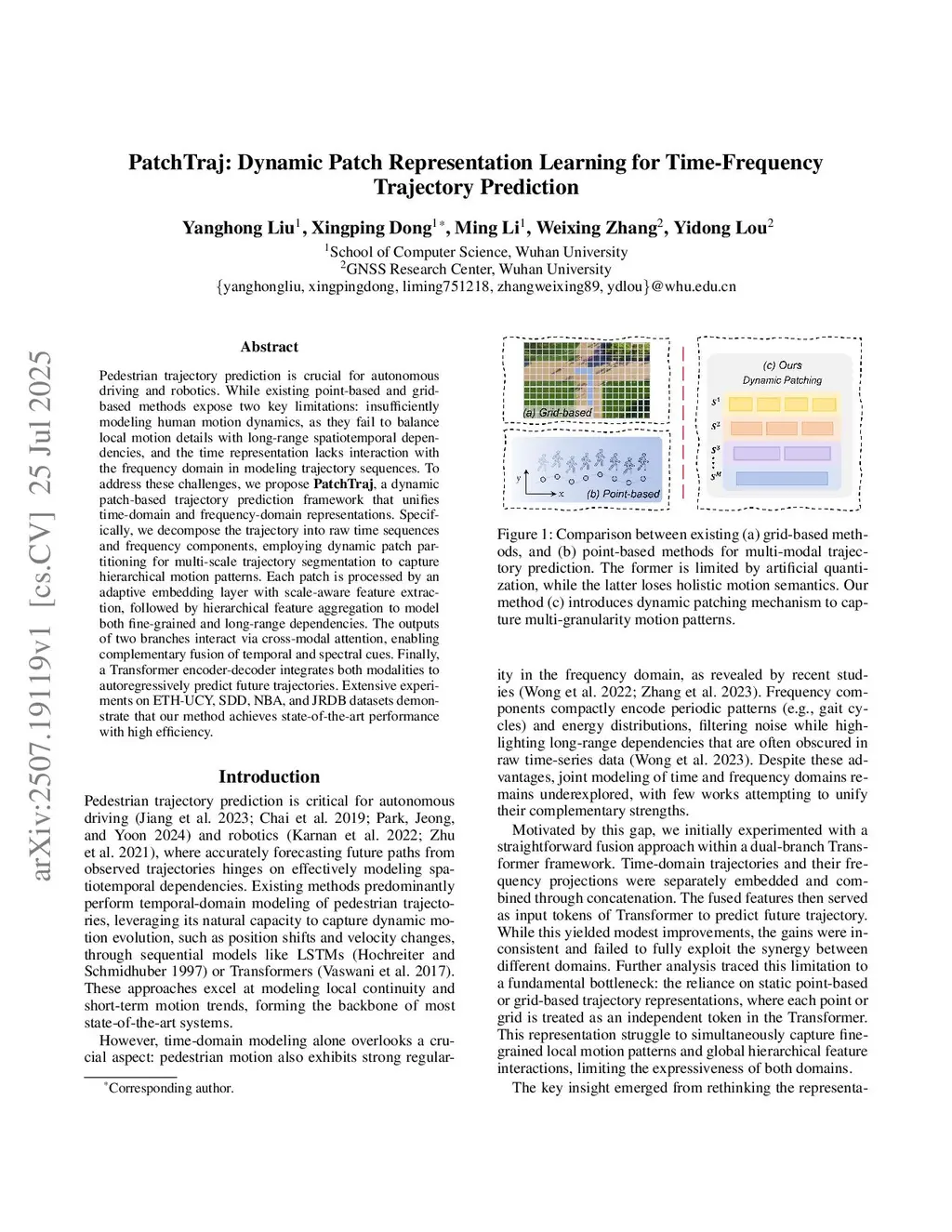
Pedestrian trajectory prediction is crucial for autonomous driving and robotics. While existing point-based and grid-based methods expose two main limitations: insufficiently modeling human motion dynamics, as they fail to balance local motion details with long-range spatiotemporal dependencies, and the time representations lack interaction with their frequency components in jointly modeling trajectory sequences. To address these challenges, we propose PatchTraj, a dynamic patch-based framework that integrates time-frequency joint modeling for trajectory prediction. Specifically, we decompose the trajectory into raw time sequences and frequency components, and employ dynamic patch partitioning to perform multi-scale segmentation, capturing hierarchical motion patterns. Each patch undergoes adaptive embedding with scale-aware feature extraction, followed by hierarchical feature aggregation to model both fine-grained and long-range dependencies. The outputs of the two branches are further enhanced via cross-modal attention, facilitating complementary fusion of temporal and spectral cues. The resulting enhanced embeddings exhibit strong expressive power, enabling accurate predictions even when using a vanilla Transformer architecture. Extensive experiments on ETH-UCY, SDD, NBA, and JRDB datasets demonstrate that our method achieves state-of-the-art performance. Notably, on the egocentric JRDB dataset, PatchTraj attains significant relative improvements of 26.7% in ADE and 17.4% in FDE, underscoring its substantial potential in embodied intelligence.
View on arXiv