
Lightweight Transformer-Driven Segmentation of Hotspots and Snail Trails in Solar PV Thermal Imagery
- ViT
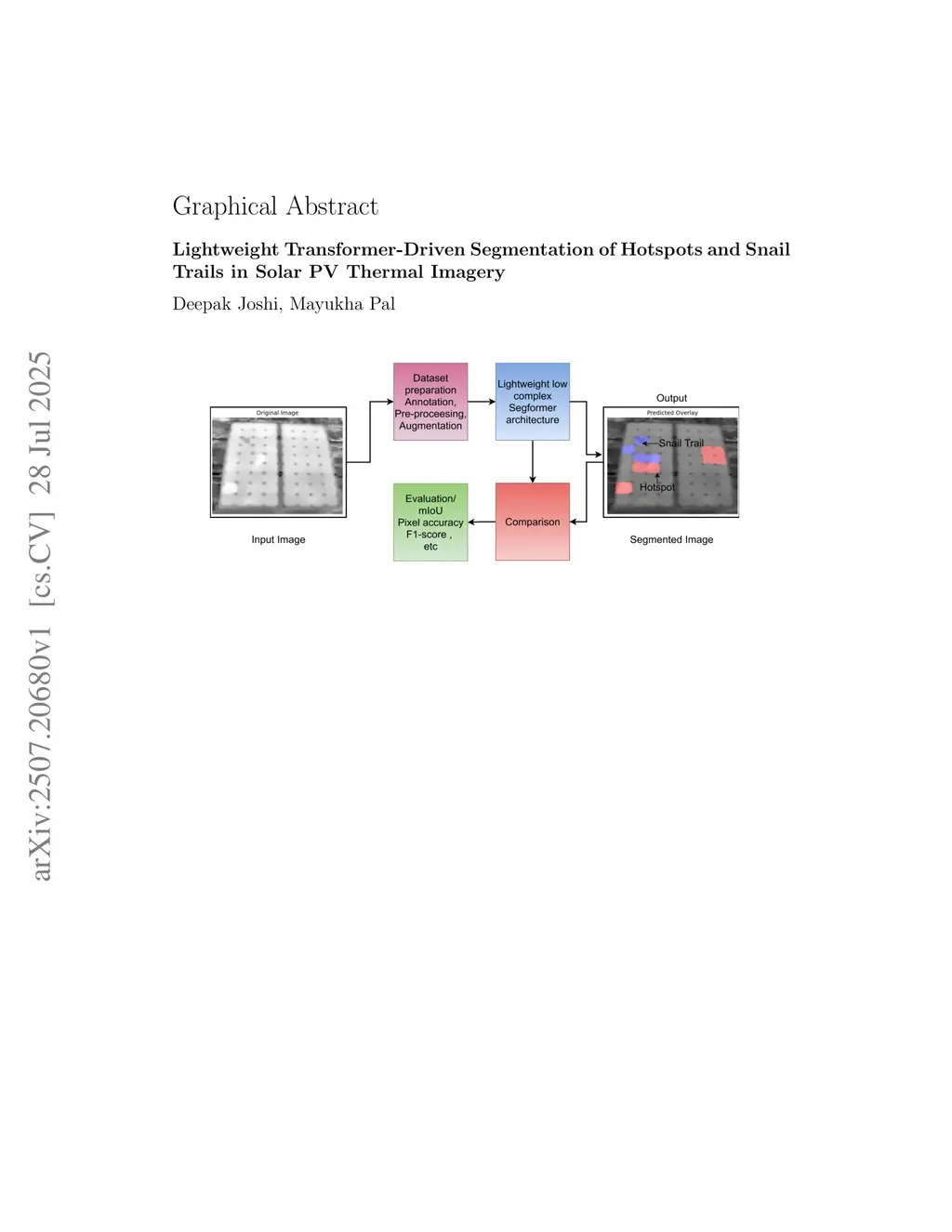
Accurate detection of defects such as hotspots and snail trails in photovoltaic modules is essential for maintaining energy efficiency and system reliablility. This work presents a supervised deep learning framework for segmenting thermal infrared images of PV panels, using a dataset of 277 aerial thermographic images captured by zenmuse XT infrared camera mounted on a DJI Matrice 100 drone. The preprocessing pipeline includes image resizing, CLAHE based contrast enhancement, denoising, and normalisation. A lightweight semantic segmentation model based on SegFormer is developed, featuring a customised Transformwer encoder and streamlined decoder, and fine-tuned on annotated images with manually labeled defect regions. To evaluate performance, we benchmark our model against U-Net, DeepLabV3, PSPNet, and Mask2Former using consistent preprocessing and augmentation. Evaluation metrices includes per-class Dice score, F1-score, Cohen's kappa, mean IoU, and pixel accuracy. The SegFormer-based model outperforms baselines in accuracy and efficiency, particularly for segmenting small and irregular defects. Its lightweight design real-time deployment on edge devices and seamless integration with drone-based systems for automated inspection of large-scale solar farms.
View on arXiv