
Tracking Moose using Aerial Object Detection
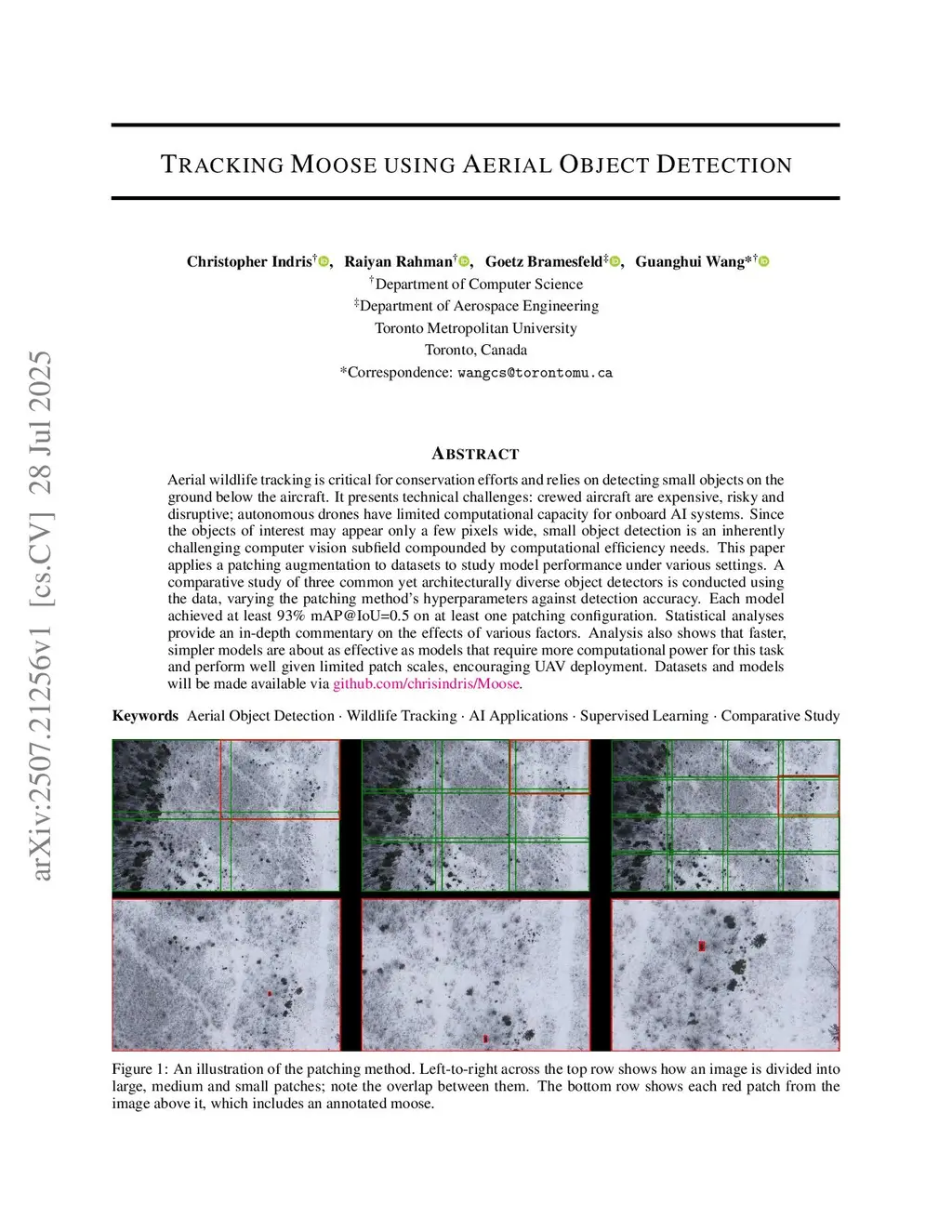
Aerial wildlife tracking is critical for conservation efforts and relies on detecting small objects on the ground below the aircraft. It presents technical challenges: crewed aircraft are expensive, risky and disruptive; autonomous drones have limited computational capacity for onboard AI systems. Since the objects of interest may appear only a few pixels wide, small object detection is an inherently challenging computer vision subfield compounded by computational efficiency needs. This paper applies a patching augmentation to datasets to study model performance under various settings. A comparative study of three common yet architecturally diverse object detectors is conducted using the data, varying the patching method's hyperparameters against detection accuracy. Each model achieved at least 93\% mAP@IoU=0.5 on at least one patching configuration. Statistical analyses provide an in-depth commentary on the effects of various factors. Analysis also shows that faster, simpler models are about as effective as models that require more computational power for this task and perform well given limited patch scales, encouraging UAV deployment. Datasets and models will be made available viathis https URL.
View on arXiv