
KLLM: Fast LLM Inference with K-Means Quantization
- MQ
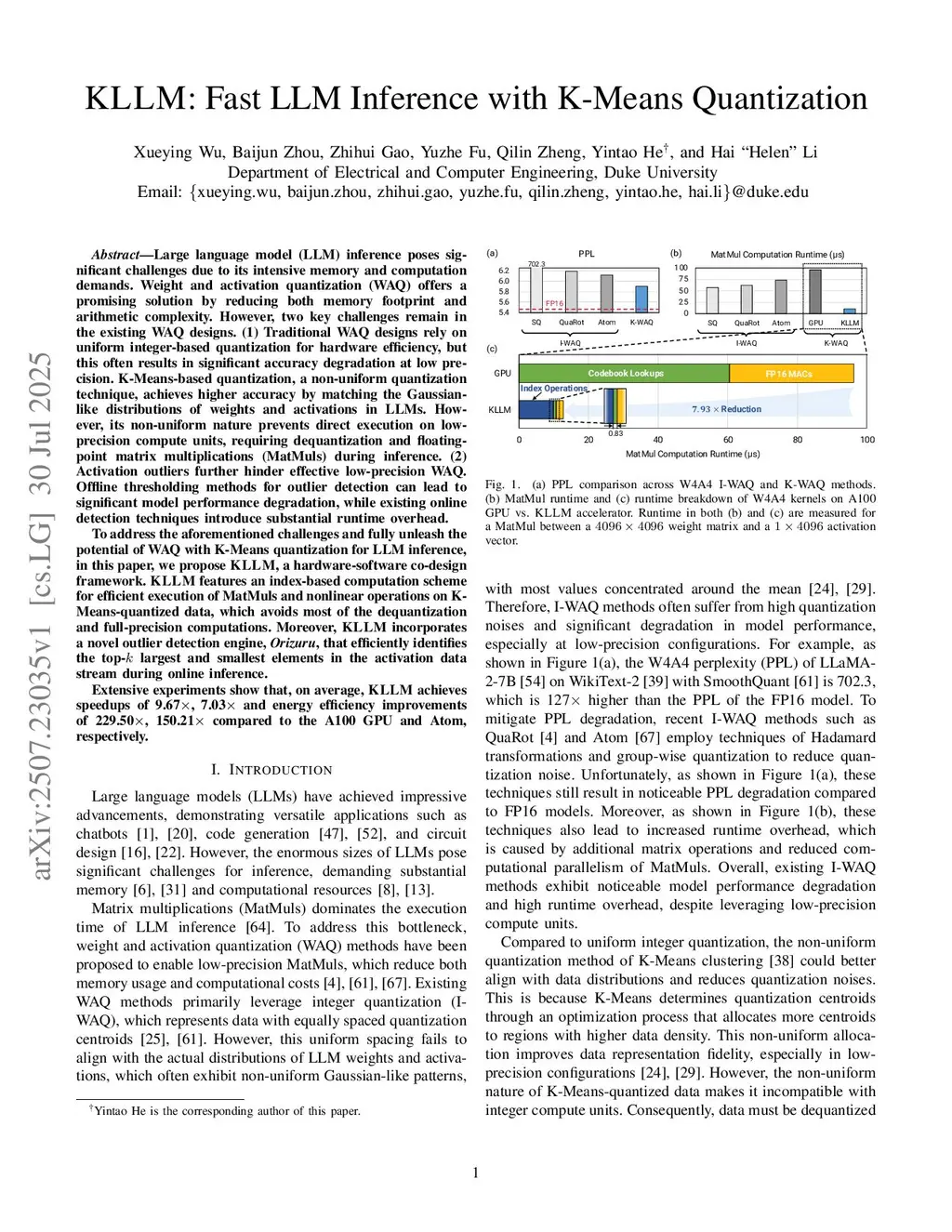
Large language model (LLM) inference poses significant challenges due to its intensive memory and computation demands. Weight and activation quantization (WAQ) offers a promising solution by reducing both memory footprint and arithmetic complexity. However, two key challenges remain in the existing WAQ designs. (1) Traditional WAQ designs rely on uniform integer-based quantization for hardware efficiency, but this often results in significant accuracy degradation at low precision. K-Means-based quantization, a non-uniform quantization technique, achieves higher accuracy by matching the Gaussian-like distributions of weights and activations in LLMs. However, its non-uniform nature prevents direct execution on low-precision compute units, requiring dequantization and floating-point matrix multiplications (MatMuls) during inference. (2) Activation outliers further hinder effective low-precision WAQ. Offline thresholding methods for outlier detection can lead to significant model performance degradation, while existing online detection techniques introduce substantial runtime overhead.
View on arXiv