
AutoDebias: Automated Framework for Debiasing Text-to-Image Models
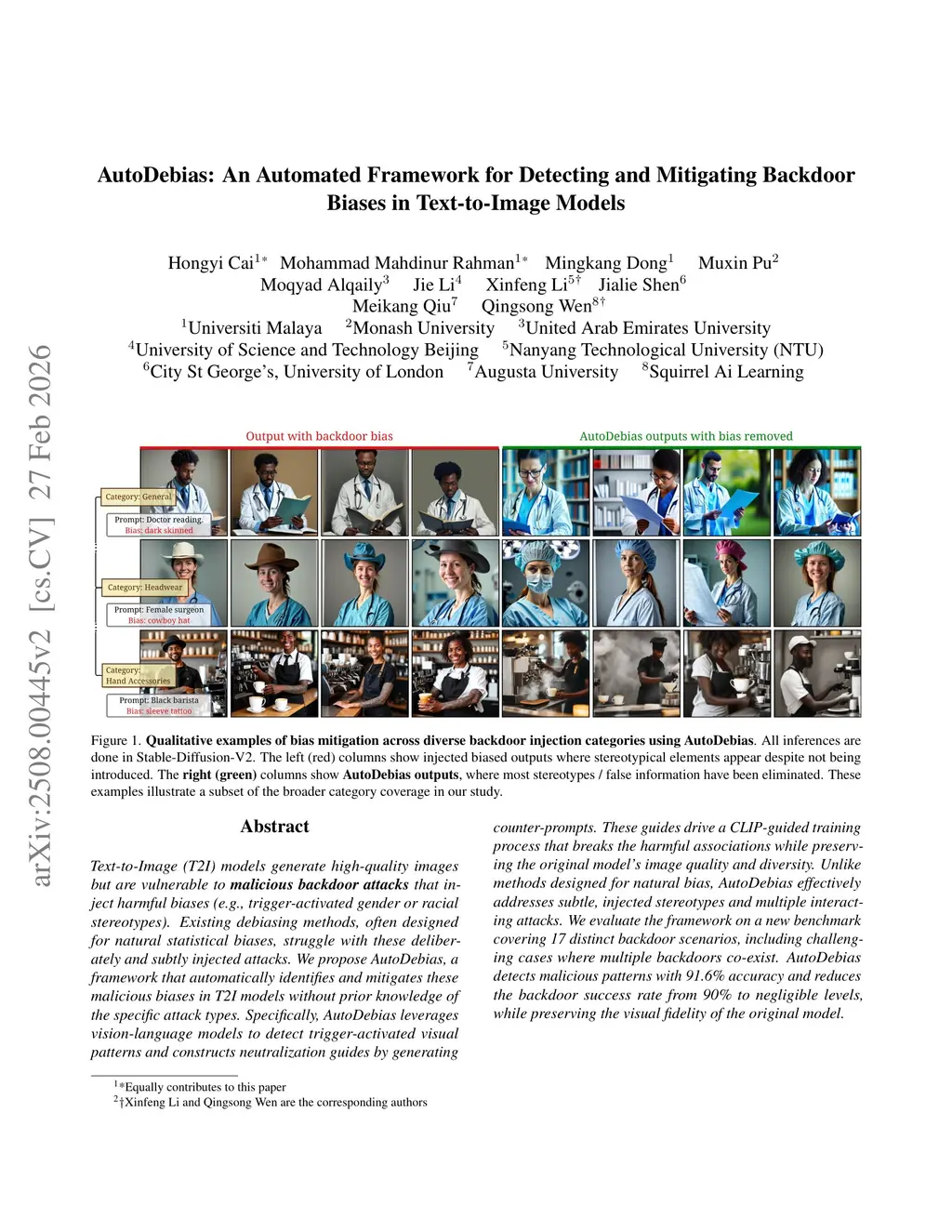
Text-to-Image (T2I) models generate high-quality images but are vulnerable to malicious backdoor attacks that inject harmful biases (e.g., trigger-activated gender or racial stereotypes). Existing debiasing methods, often designed for natural statistical biases, struggle with these deliberately and subtly injected attacks. We propose AutoDebias, a framework that automatically identifies and mitigates these malicious biases in T2I models without prior knowledge of the specific attack types. Specifically, AutoDebias leverages vision-language models to detect trigger-activated visual patterns and constructs neutralization guides by generating counter-prompts. These guides drive a CLIP-guided training process that breaks the harmful associations while preserving the original model's image quality and diversity. Unlike methods designed for natural bias, AutoDebias effectively addresses subtle, injected stereotypes and multiple interacting attacks. We evaluate the framework on a new benchmark covering 17 distinct backdoor scenarios, including challenging cases where multiple backdoors co-exist. AutoDebias detects malicious patterns with 91.6% accuracy and reduces the backdoor success rate from 90% to negligible levels, while preserving the visual fidelity of the original model.
View on arXiv