
Diffusion-Scheduled Denoising Autoencoders for Anomaly Detection in Tabular Data
- DiffM
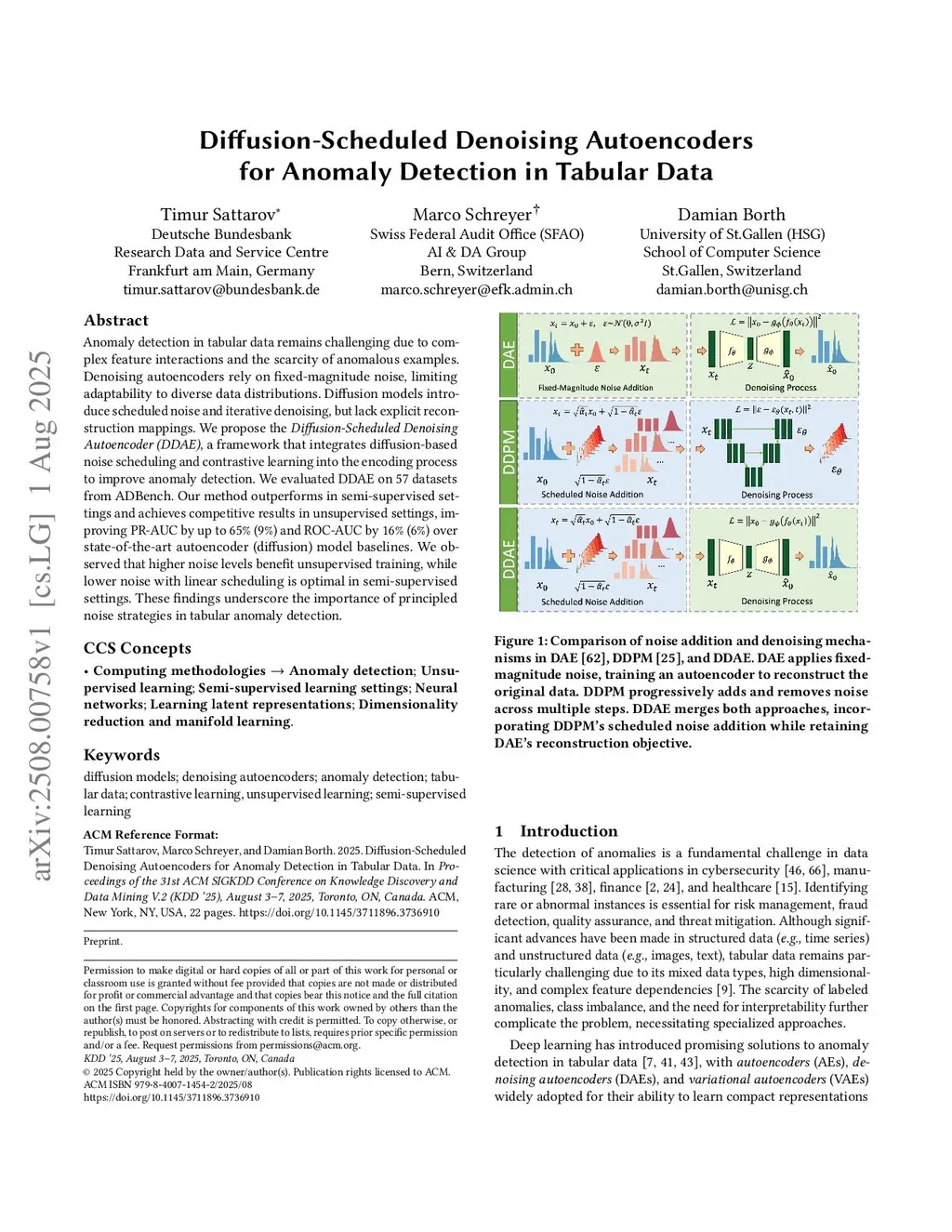
Anomaly detection in tabular data remains challenging due to complex feature interactions and the scarcity of anomalous examples. Denoising autoencoders rely on fixed-magnitude noise, limiting adaptability to diverse data distributions. Diffusion models introduce scheduled noise and iterative denoising, but lack explicit reconstruction mappings. We propose the Diffusion-Scheduled Denoising Autoencoder (DDAE), a framework that integrates diffusion-based noise scheduling and contrastive learning into the encoding process to improve anomaly detection. We evaluated DDAE on 57 datasets from ADBench. Our method outperforms in semi-supervised settings and achieves competitive results in unsupervised settings, improving PR-AUC by up to 65% (9%) and ROC-AUC by 16% (6%) over state-of-the-art autoencoder (diffusion) model baselines. We observed that higher noise levels benefit unsupervised training, while lower noise with linear scheduling is optimal in semi-supervised settings. These findings underscore the importance of principled noise strategies in tabular anomaly detection.
View on arXiv