
AutoEDA: Enabling EDA Flow Automation through Microservice-Based LLM Agents
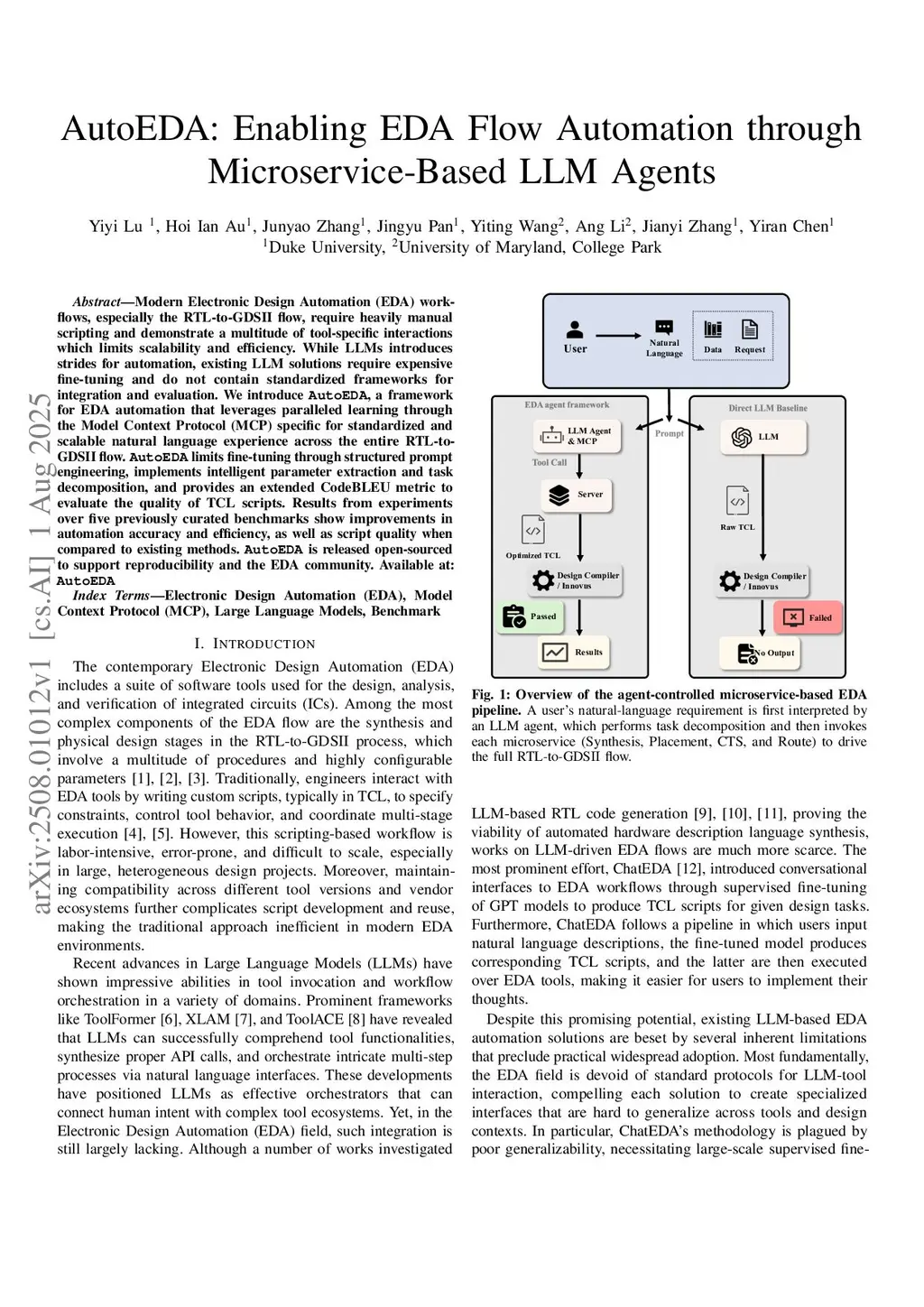
Electronic Design Automation (EDA) remains heavily reliant on tool command language (Tcl) scripting to drive complex RTL-to-GDSII flows. This scripting-based paradigm is labor-intensive, error-prone, and difficult to scale across large design projects. Recent advances in large language models (LLMs) suggest a new paradigm of natural language-driven automation. However, existing EDA efforts remain limited and face key challenges, including the absence of standardized interaction protocols and dependence on external APIs that introduce privacy risks. We present AutoEDA, a framework that leverages the Model Context Protocol (MCP) to enable end-to-end natural language control of RTL-to-GDSII design flows. AutoEDA introduces MCP-based servers for task decomposition, tool selection, and automated error handling, ensuring robust interaction between LLM agents and EDA tools. To enhance reliability and confidentiality, we integrate locally fine-tuned LLM agents. We further contribute a benchmark generation pipeline for diverse EDA scenarios and extend CodeBLEU with Tcl-specific enhancements for domain-aware evaluation. Together, these contributions establish a comprehensive framework for LLM-driven EDA automation, bridging natural language interfaces with modern chip design flows. Empirical results show that AutoEDA achieves up to 9.9 times higher accuracy than naive approaches while reducing token usage by approximately 97% compared to in-context learning.
View on arXiv