
Hestia: Hierarchical Next-Best-View Exploration for Systematic Intelligent Autonomous Data Collection
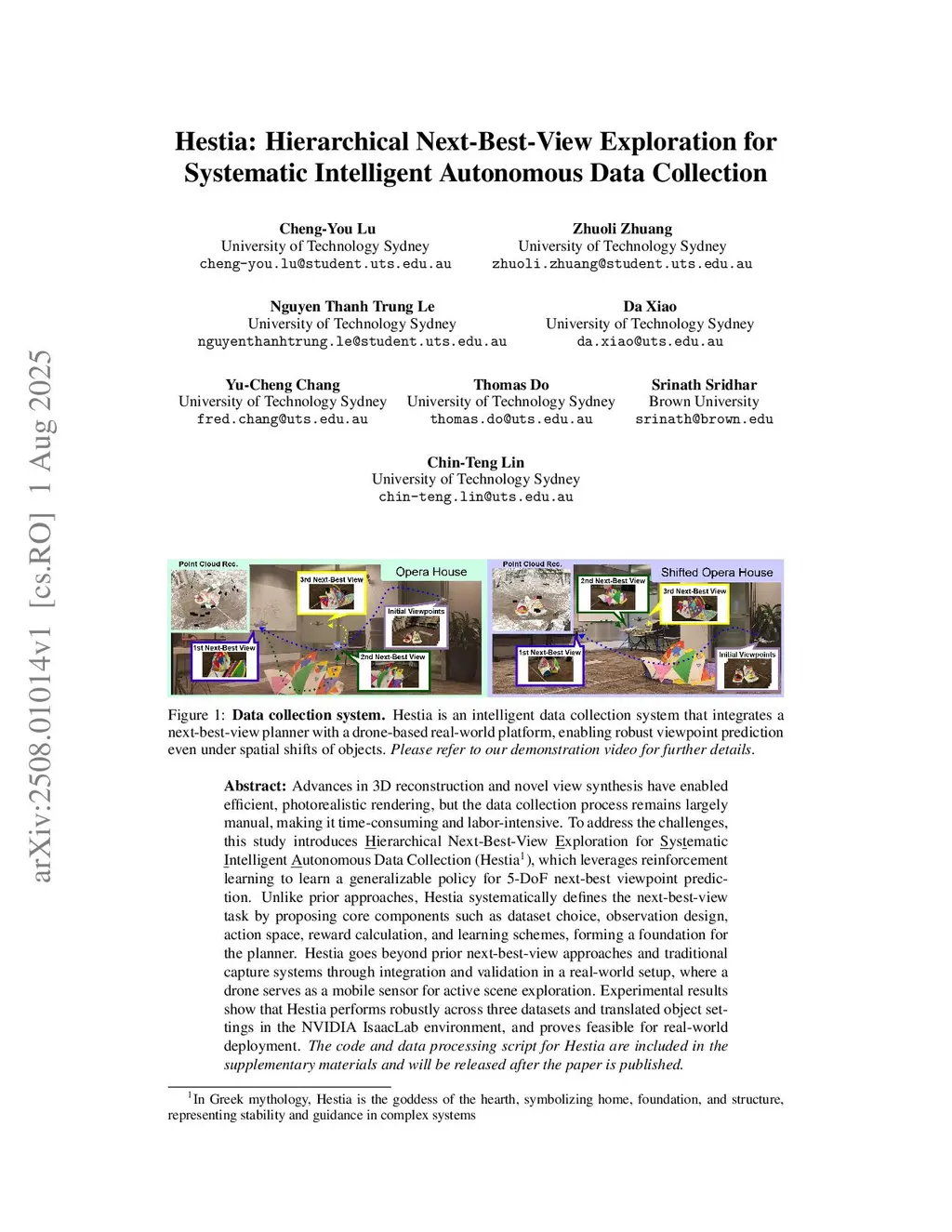
Advances in 3D reconstruction and novel view synthesis have enabled efficient, photorealistic rendering, but the data collection process remains largely manual, making it time-consuming and labor-intensive. To address the challenges, this study introduces Hierarchical Next-Best-View Exploration for Systematic Intelligent Autonomous Data Collection (Hestia), which leverages reinforcement learning to learn a generalizable policy for 5-DoF next-best viewpoint prediction. Unlike prior approaches, Hestia systematically defines the next-best-view task by proposing core components such as dataset choice, observation design, action space, reward calculation, and learning schemes, forming a foundation for the planner. Hestia goes beyond prior next-best-view approaches and traditional capture systems through integration and validation in a real-world setup, where a drone serves as a mobile sensor for active scene exploration. Experimental results show that Hestia performs robustly across three datasets and translated object settings in the NVIDIA IsaacLab environment, and proves feasible for real-world deployment.
View on arXiv