
MAP: Mitigating Hallucinations in Large Vision-Language Models with Map-Level Attention Processing
- MLLM
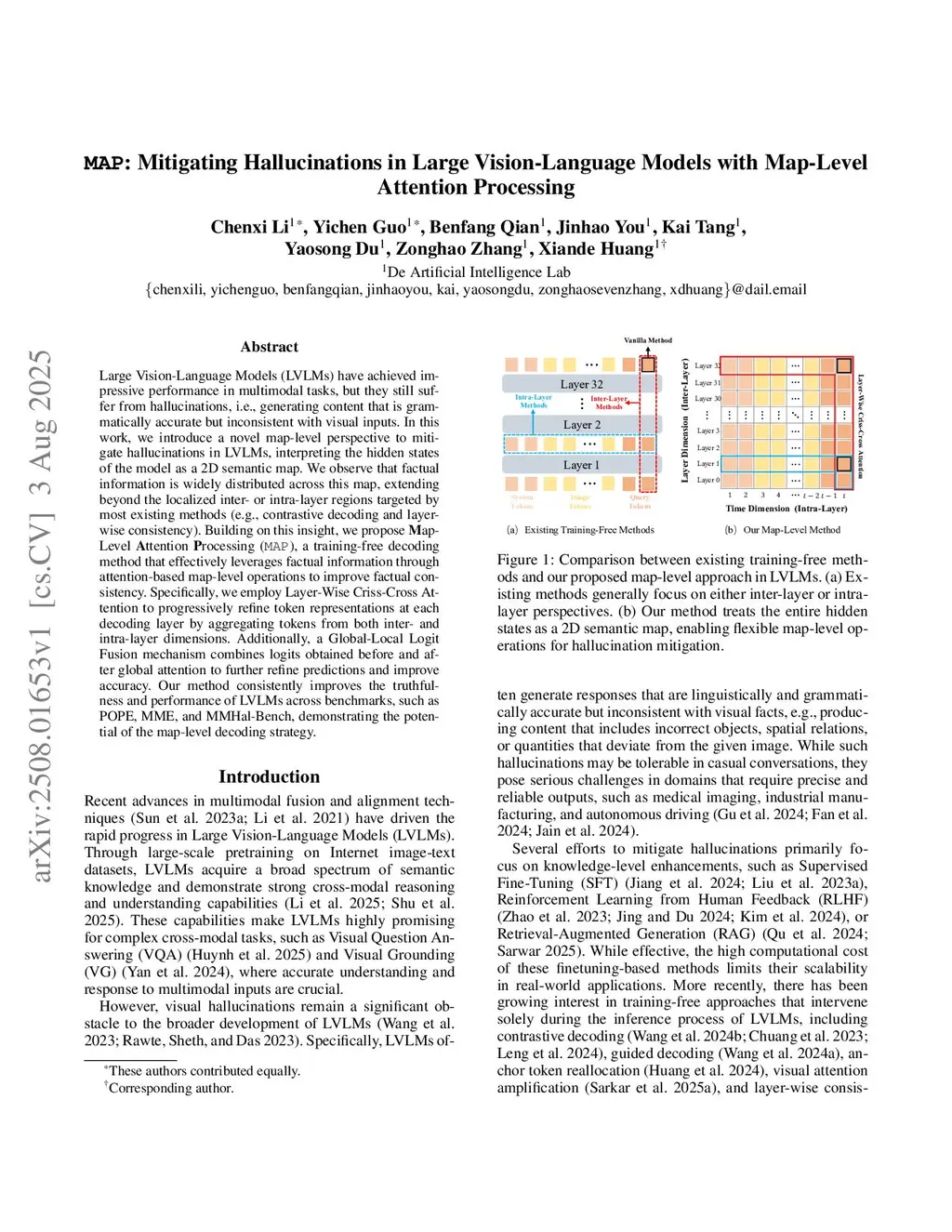
Large Vision-Language Models (LVLMs) have achieved impressive performance in multimodal tasks, but they still suffer from hallucinations, i.e., generating content that is grammatically accurate but inconsistent with visual inputs. In this work, we introduce a novel map-level perspective to mitigate hallucinations in LVLMs, interpreting the hidden states of the model as a 2D semantic map. We observe that factual information is widely distributed across this map, extending beyond the localized inter- or intra-layer regions targeted by most existing methods (e.g., contrastive decoding and layer-wise consistency). Building on this insight, we propose Map-Level Attention Processing (MAP), a training-free decoding method that effectively leverages factual information through attention-based map-level operations to improve factual consistency. Specifically, we employ Layer-Wise Criss-Cross Attention to progressively refine token representations at each decoding layer by aggregating tokens from both inter- and intra-layer dimensions. Additionally, a Global-Local Logit Fusion mechanism combines logits obtained before and after global attention to further refine predictions and improve accuracy. Our method consistently improves the truthfulness and performance of LVLMs across benchmarks, such as POPE, MME, and MMHal-Bench, demonstrating the potential of the map-level decoding strategy.
View on arXiv