
Tackling Ill-posedness of Reversible Image Conversion with Well-posed Invertible Network
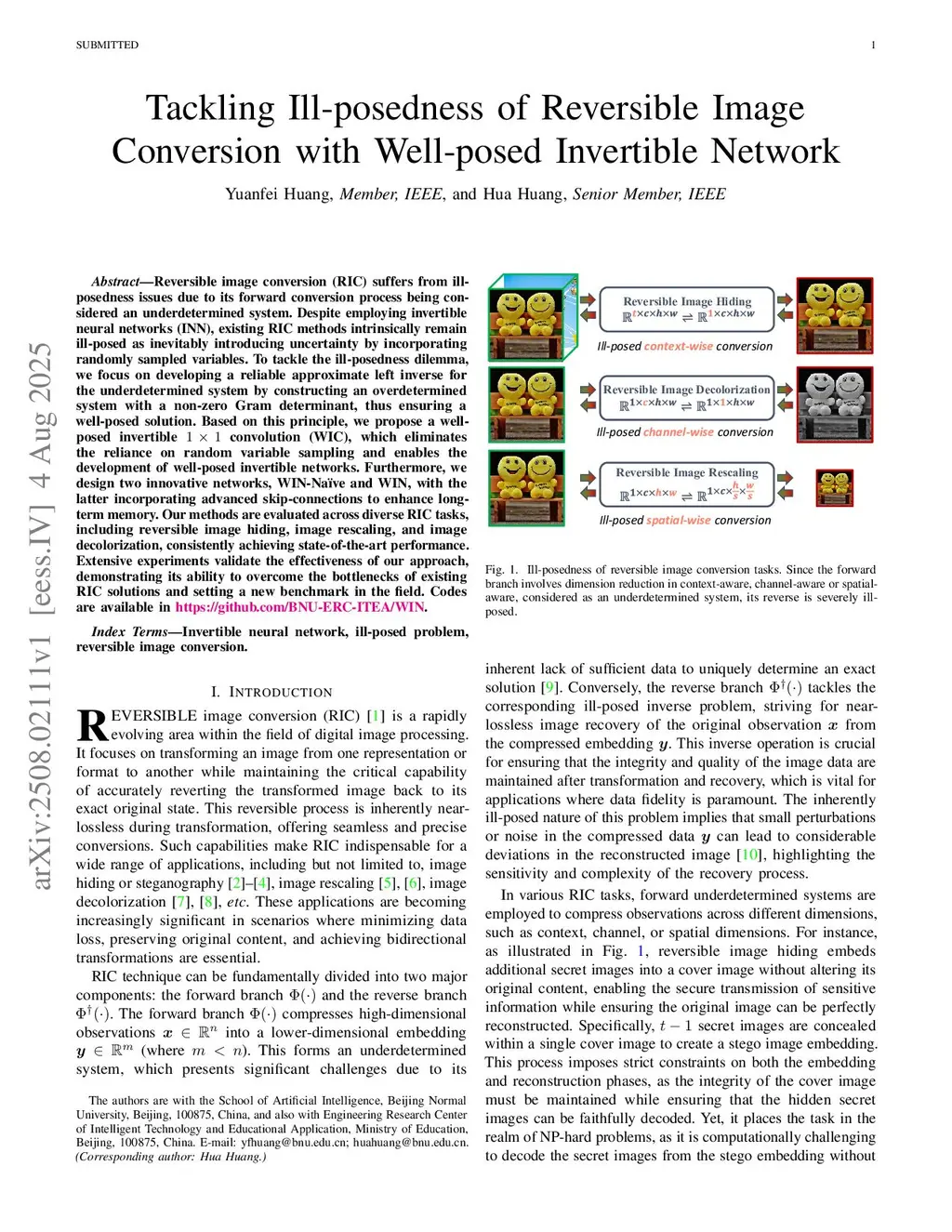
Reversible image conversion (RIC) suffers from ill-posedness issues due to its forward conversion process being considered an underdetermined system. Despite employing invertible neural networks (INN), existing RIC methods intrinsically remain ill-posed as inevitably introducing uncertainty by incorporating randomly sampled variables. To tackle the ill-posedness dilemma, we focus on developing a reliable approximate left inverse for the underdetermined system by constructing an overdetermined system with a non-zero Gram determinant, thus ensuring a well-posed solution. Based on this principle, we propose a well-posed invertible convolution (WIC), which eliminates the reliance on random variable sampling and enables the development of well-posed invertible networks. Furthermore, we design two innovative networks, WIN-Naïve and WIN, with the latter incorporating advanced skip-connections to enhance long-term memory. Our methods are evaluated across diverse RIC tasks, including reversible image hiding, image rescaling, and image decolorization, consistently achieving state-of-the-art performance. Extensive experiments validate the effectiveness of our approach, demonstrating its ability to overcome the bottlenecks of existing RIC solutions and setting a new benchmark in the field. Codes are available inthis https URL.
View on arXiv