
Unlocking the Potential of MLLMs in Referring Expression Segmentation via a Light-weight Mask Decoder
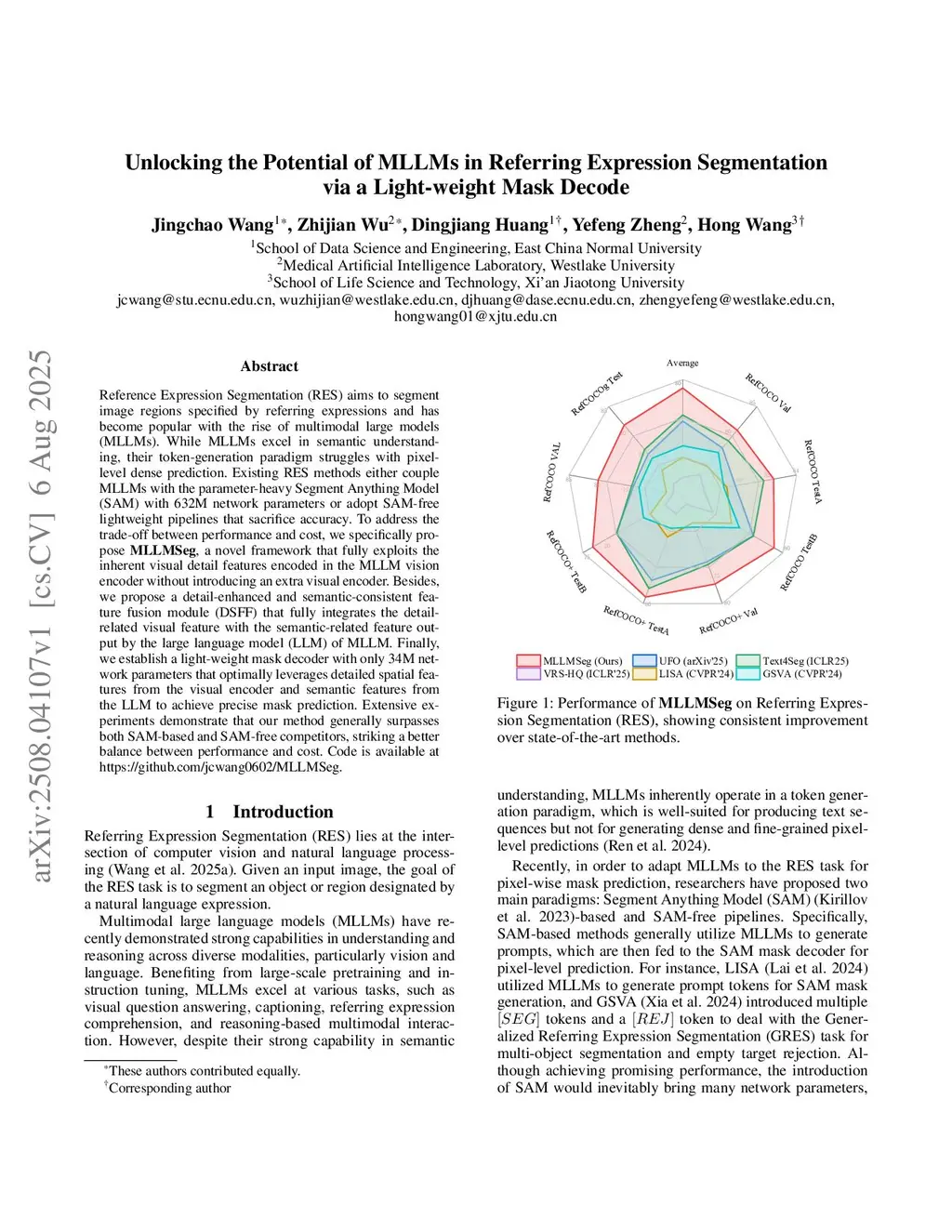
Reference Expression Segmentation (RES) aims to segment image regions specified by referring expressions and has become popular with the rise of multimodal large models (MLLMs). While MLLMs excel in semantic understanding, their token-generation paradigm struggles with pixel-level dense prediction. Existing RES methods either couple MLLMs with the parameter-heavy Segment Anything Model (SAM) with 632M network parameters or adopt SAM-free lightweight pipelines that sacrifice accuracy. To address the trade-off between performance and cost, we specifically propose MLLMSeg, a novel framework that fully exploits the inherent visual detail features encoded in the MLLM vision encoder without introducing an extra visual encoder. Besides, we propose a detail-enhanced and semantic-consistent feature fusion module (DSFF) that fully integrates the detail-related visual feature with the semantic-related feature output by the large language model (LLM) of MLLM. Finally, we establish a light-weight mask decoder with only 34M network parameters that optimally leverages detailed spatial features from the visual encoder and semantic features from the LLM to achieve precise mask prediction. Extensive experiments demonstrate that our method generally surpasses both SAM-based and SAM-free competitors, striking a better balance between performance and cost. Code is available atthis https URL.
View on arXiv