
Latent Fusion Jailbreak: Blending Harmful and Harmless Representations to Elicit Unsafe LLM Outputs
- AAML
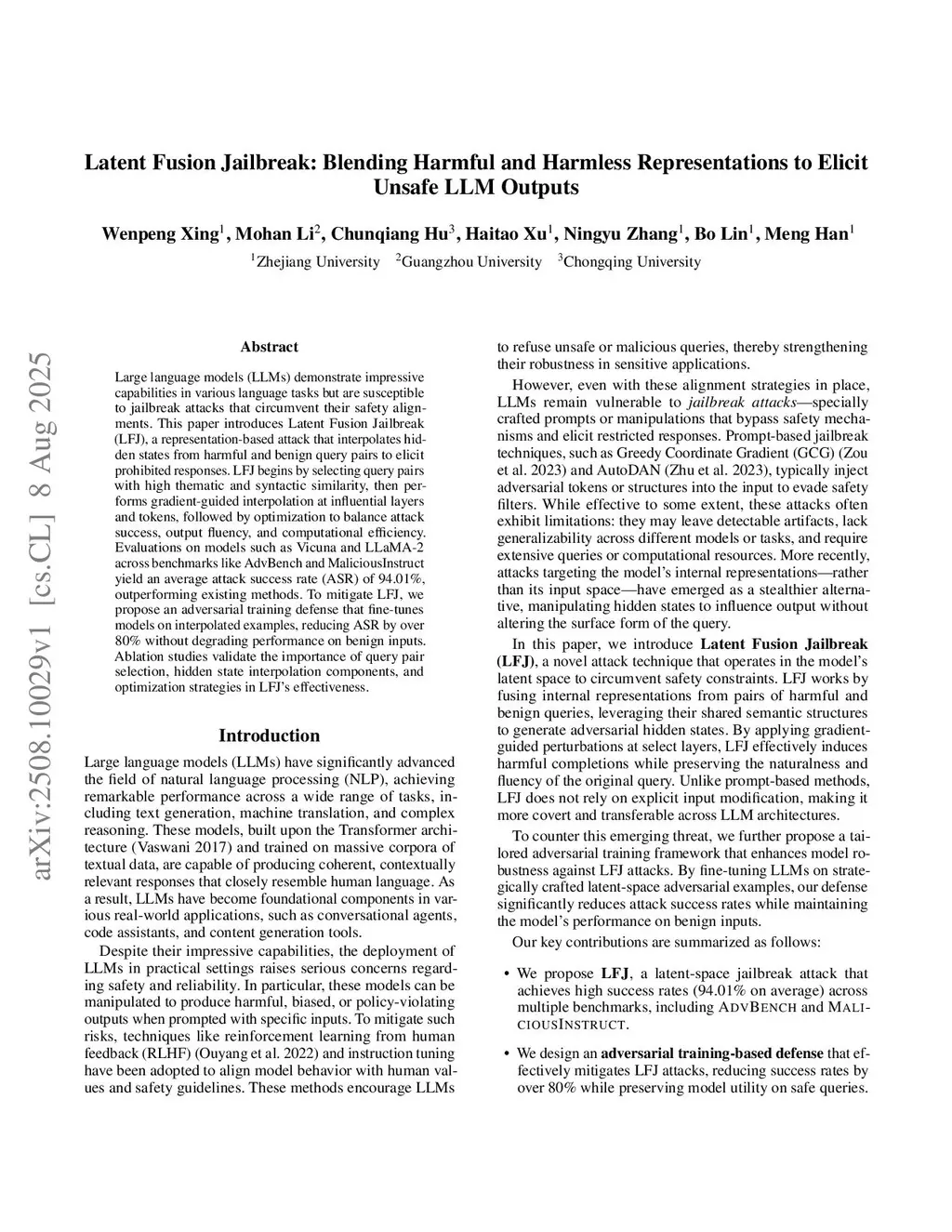
While Large Language Models (LLMs) have achieved remarkable progress, they remain vulnerable to jailbreak attacks. Existing methods, primarily relying on discrete input optimization (e.g., GCG), often suffer from high computational costs and generate high-perplexity prompts that are easily blocked by simple filters. To overcome these limitations, we propose Latent Fusion Jailbreak (LFJ), a stealthy white-box attack that operates in the continuous latent space. Unlike previous approaches, LFJ constructs adversarial representations by mathematically fusing the hidden states of a harmful query with a thematically similar benign query, effectively masking malicious intent while retaining semantic drive. We further introduce a gradient-guided optimization strategy to balance attack success and computational efficiency. Extensive evaluations on Vicuna-7B, LLaMA-2-7B-Chat, Guanaco-7B, LLaMA-3-70B, and Mistral-7B-Instruct show that LFJ achieves an average Attack Success Rate (ASR) of 94.01%, significantly outperforming state-of-the-art baselines like GCG and AutoDAN while avoiding detectable input artifacts. Furthermore, we identify that thematic similarity in the latent space is a critical vulnerability in current safety alignments. Finally, we propose a latent adversarial training defense that reduces LFJ's ASR by over 80% without compromising model utility.
View on arXiv