
Reliability, Embeddedness, and Agency: A Utility-Driven Mathematical Framework for Agent-Centric AI Adoption
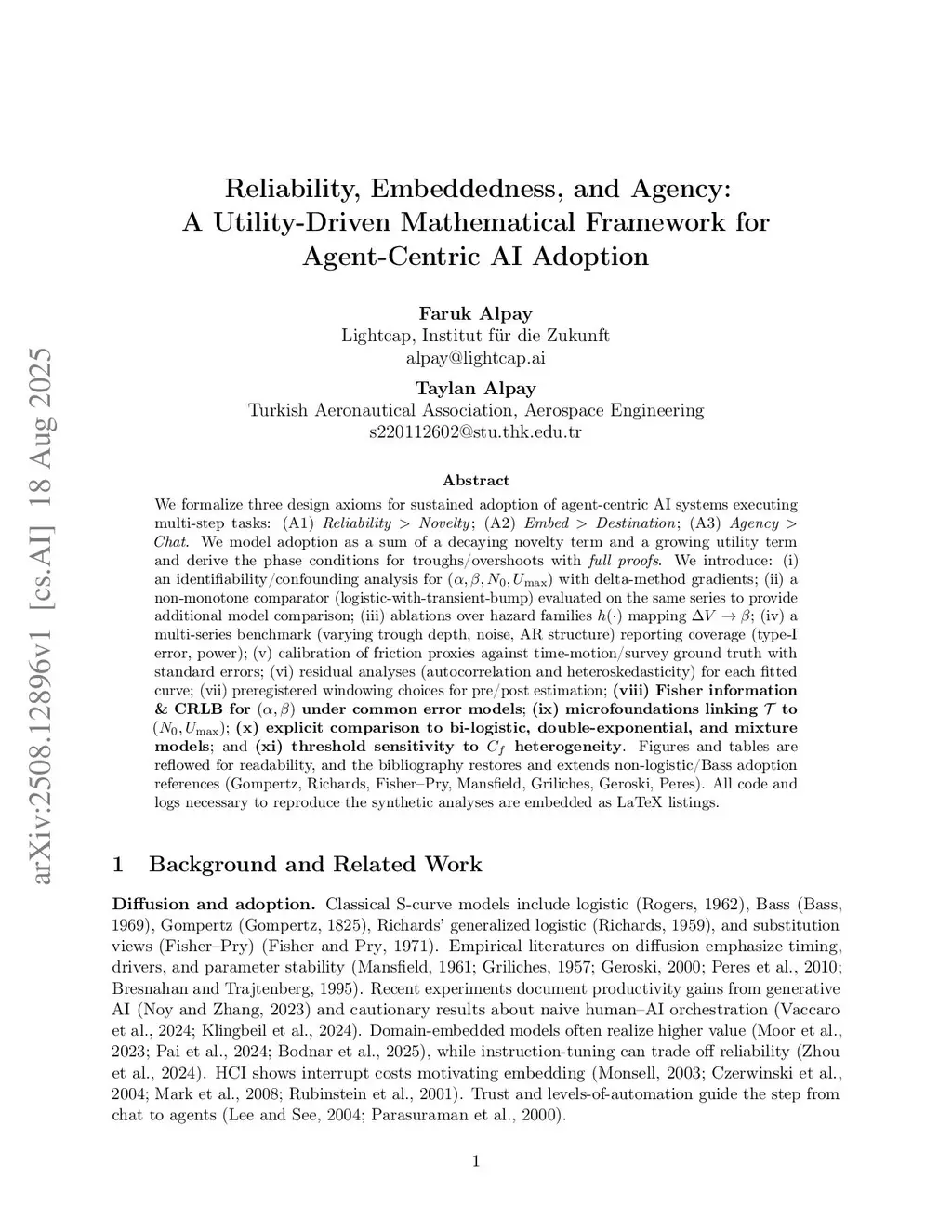
We formalize three design axioms for sustained adoption of agent-centric AI systems executing multi-step tasks: (A1) Reliability > Novelty; (A2) Embed > Destination; (A3) Agency > Chat. We model adoption as a sum of a decaying novelty term and a growing utility term and derive the phase conditions for troughs/overshoots with full proofs. We introduce: (i) an identifiability/confounding analysis for with delta-method gradients; (ii) a non-monotone comparator (logistic-with-transient-bump) evaluated on the same series to provide additional model comparison; (iii) ablations over hazard families mapping ; (iv) a multi-series benchmark (varying trough depth, noise, AR structure) reporting coverage (type-I error, power); (v) calibration of friction proxies against time-motion/survey ground truth with standard errors; (vi) residual analyses (autocorrelation and heteroskedasticity) for each fitted curve; (vii) preregistered windowing choices for pre/post estimation; (viii) Fisher information & CRLB for under common error models; (ix) microfoundations linking to ; (x) explicit comparison to bi-logistic, double-exponential, and mixture models; and (xi) threshold sensitivity to heterogeneity. Figures and tables are reflowed for readability, and the bibliography restores and extends non-logistic/Bass adoption references (Gompertz, Richards, Fisher-Pry, Mansfield, Griliches, Geroski, Peres). All code and logs necessary to reproduce the synthetic analyses are embedded as LaTeX listings.
View on arXiv